Crazy Rich Asians
Directed by John M. Chu
Based on the novel by Kevin Kwan
Rated PG
*SLIGHT SPOILERS AHEAD*
I’d be lying if I didn’t say that the film is flawed. It’s choppy, it’s predictable, many characters are thinly portrayed and the lead guy could use some more acting workshops (granted, he is new and this is his first film.)
Having said that, Crazy Rich Asians is a scrumptious helping of extravagance, gorgeous (and charming) actors, Asian family values and that glorious virture of standing up for one’s self. It’s quite satisfying to watch an all-Asian cast in a Hollywood movie. So c’mon, ‘Merica, make more of these cuz we (Asians) are gonna watch them.
Let’s make things clear: this is a Hollywood romantic comedy starring mostly Asians and Asian-Americans, about an Asian-American woman who finds herself not Asian enough when she meets her boyfriend’s family in Singapore. It’s not an Asian movie about all Asians. And it’s fictional. A fantasy.
In the film, a New York economics professor flies to Singapore to meet her boyfriend’s family and friends who turn out to be the titular crazy rich Asians.


Images from Warner Brothers Pictures
Rachel (Fresh Off The Boat’s Constance Wu) is an Asian-American game-theorist NYU economics professor who reluctantly agrees to attend the wedding of her boyfriend Nick’s (Henry Golding) best friend Colin (Chris Pang) in Singapore and also meet Nick’s friends and family while there. Nick never talked about his family with Rachel, so it comes to Rachel’s surprise that Nick is heir to a grand family fortune, and her landing in Singapore would stir the proverbial hornet’s nest and its queen, Nick’s regal mother Eleanor (the legendary Michelle Yeoh.)
Fortunately for Rachel to successfully walk over Asian eggshells, she finds support from her college pal Peik Lin (Awkwafina, for the Globes!) Nick’s close cousin Astrid (gorgeous Gemma Chan) and other cousin Oliver (Nico Santos, Pinoy reprazent.) But it would take more than guts for Rachel to survive the crazy trip without her getting stung.
The story is a familiar Cinderella fairy tale, but instead of just three evil stepsisters and a stepmother, Rachel receives the sneers of an entire island-nation. Characters are a little under-developed, falling into a few genre tropes to facilitate the narrative. This is particularly obvious with Nick, whom we are all expected to accept as the dashing, down to earth prince charming without much thought into how or why or wherefore he is like that. Golding provides an adequate portrayal of Nick with some support from editing: the few scenes where he delivers some crucial lines (“I met a girl, fell in love, and I want to marry her,” “I made a mistake,” plus that climactic confrontation between him, the grandmother and Eleanor) all cut away to frames of whomever he is talking to – maybe because those emotions were not there yet. To be fair to Mr. Golding, he does have the charm and screen presence to be a bonafide leading man – a few more workshops and screen exposures will help him a lot.
The narrative is also choppy – but for good reason. Every now and then, Rachel and Nick’s romance is interrupted by that other narrative involving Astrid and her husband Michael (Pierre Png.) That story serves as a cautionary tale for what might happen to Rachel – a “commoner” like Michael – should she end up marrying Nick. It also magnifies Eleanor’s statement that Rachel will never be enough for her son. This storyline is also there as one of the many bases that the film needs to cover should (and as of this morning’s announcement, in fact) production for the sequel takes place. The sequel novel, Crazy Rich Girlfriend has more about Astrid and Charlie Wu (Harry Shum Jr, who makes a brief appearance.)
I’m curious how the film will be viewed by my fellow Filipinos. It’s already a huge hit at the local boxoffice, even though we see a lot of rom-coms from local studios and K-dramas. CRA at first glance looks like a big production of the same thing. Colonized “300 years in the convent, 50 years in Hollywood,” Filipinos would sometimes describe ourselves as less Asian and more Western. Quite strange, since the oldest Chinatown in the world is in Manila, and the capital was a Muslim stronghold before the Spaniards arrived. We could have easily been another Indonesia or Malaysia or Singapore. US soldiers in the Second World War called us their Little Brown brothers. In this sense, we’re kinda like “bananas” too as the movie puts it – yellow on the outside and white on the inside. But more like brown bananas. We’re well too aware of being looked down upon when we travel to China or Singapore or the Middle East. And yet we’re also partly racist: prone to stereotype Indians as loan sharks and to yellowface Chinese.
Despite my mother’s stories of our Spanish heritage, my siblings and I were never actually taught to habla Español. On my father’s side, we called our granny ah-ma, just like in the movie. Maybe we’re part Chinese, I don’t exactly know. What I’m saying is while I identify myself as Asian, I’m also a Filipino cognizant of the stereotyping that happens across Asia’s that CRA simply glosses over.
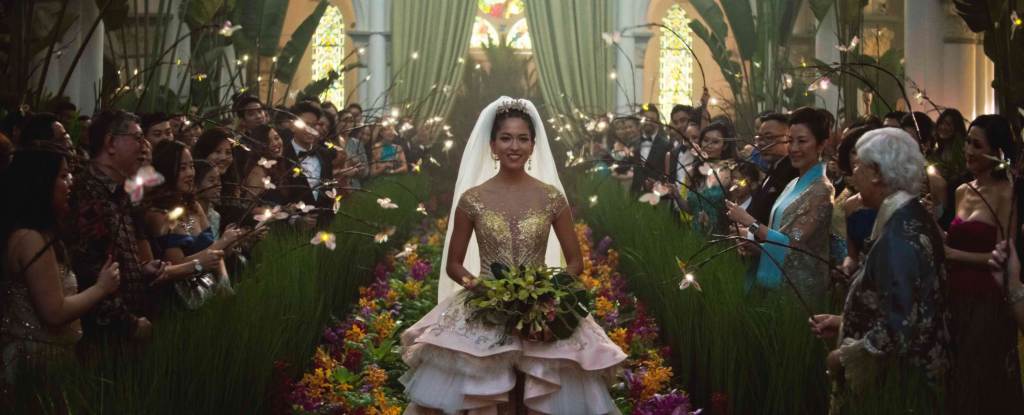
Even though I find the production design generally visually ravishing, there’s something oddly sinister with the gorgeous wedding that everyone is raving about. In the scene, the bride-to-be Araminta (Sonoya Mizuno) wades into an artificial rice paddy in the church on the way to the altar. Guests wave stalks with led lights at the tips to resemble fireflies. Beautiful scene. And yet these are crazy rich people sharing an emotional experience together in a place – however artificial – commonly associated with the meekest of Asians. The scene is so… Marie Antoinette.
But these complaints run side by side with what the film accomplishes positively.
It’s an old-school rom-com with lovable characters, charming actors, romantic settings and a story that sweeps you off of your feet.
That people ARE talking about how the film fails to adequately represent the 99-percernter Asians especially from its own Singaporean backyard is a good thing. Because of CRA’s boxoffice success, Hollywood is now conscious that Asian is not a monolithic thing.
Ken Jeong’s few lines are both uproariously funny and loaded words. Upon meeting Rachel in his Trumpesque home, he fakes stammering in English before admitting that he indeed speaks fluent English. He also jokes about starving American children. Peik Lin tells Rachel that she’s not an animal. Cousin Bernard’s (Jimmy O. Yang) wild bachelor party has Caucasians as the help. It’s not often that you see or hear Asians in a Hollywood film turning the tables around for the non-Asian people in the audience to see and hear.
And Singapore! The film is practically a glorified tourism ad featuring the small nation’s renowned street food and impressive urban landscapes.
For awards handicappers, there’s the film’s lavish design and costumes, Brian Tyler’s music and the Mando-pop soundtrack, and maybe cinematography. The Globes will be all over this film.
Crazy Rich Asians also has a lot of heart. The film celebrates (though somewhat mostly Western-friendly) Asian traditions, particularly familial bond. Career is a family thing. Marriage is a family thing. Food is a family thing. Happiness is a family thing. Yeoh explains in an article that she accepted the role only after changes in her character were made to avoid the tiger mom stereotype. For Eleanor, family is everything. And that’s very Asian – from Laos to Kathmandu.
In what could be a masterclass in film adaptation, nuancing and symbolism (especially if you know how to play the game as I do), the now-much talked-about mahjong scene (a departure from the book) highlights the film’s conflict between Rachel and Eleanor though a traditional Chinese card game. West versus East, personal versus familial, integrity versus pride. (For a deeper eplanation of the scene, there’s this article from Vox here.) You’d cheer for Rachel after that scene, but you will also feel for Eleanor.
In the end, the Rachel from New York remains intact. She chooses to remain Asian-American. She chooses her self-worth. She also makes sure that Eleanor understands that she understands what family means. And that’s not a Cinderella story anymore.
Hello, Hollywood. Asians have arrived.
 acid reflects
Leave a comment