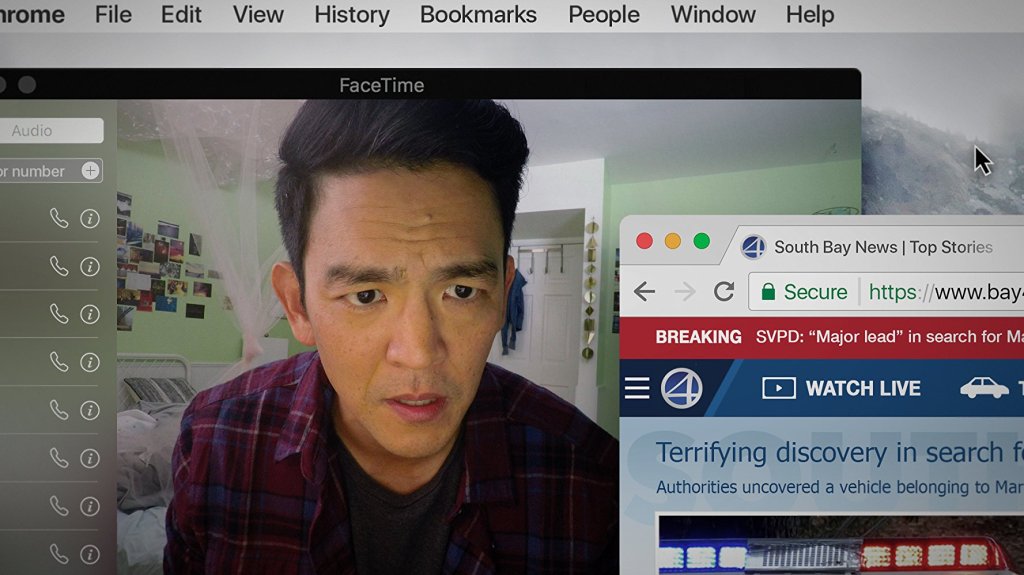
Twisty mystery that makes you sit through a simulated screen showing all manner of social media sounds like a recent sub-genre gimmick, but John Cho makes it emotionally engaging as a distraught father at wit’s end in search of his missing daughter. You’ll also start to wonder how pervasive the Internet is in our lives. Searching deserves a lot of “Likes.”
Searching
Written and Directed by Aneesh Chaganty
Since the recent death of David Kim’s (John Cho) wife to illness, he and his teen daughter Margot (newcomer Michelle La) have steadily become distant to one another, even though he tries to communicate with her often.
Margot doesn’t come home from group study the previous night, and she’s not at her piano lessons the next morning. Nor is she at school. David reports her missing, and Detective Rosemary Vick (Debra Messing) comes in to investigate. Upon Vick’s advise, David breaks into Margot’s laptop to look for clues. However, it seems that the more he delves into Margot’s life on social media, the less he learns about his daughter. With no leads even after a search crew and media attention, David decides to conduct the investigation himself before things could get even worse.
We have to acknowledge Cho for singlehandedly keeping the film emotionally engaging for an otherwise impersonal screen technique. Cho keeps the Asian American flag in Hollywood flying high, just a few weeks after Crazy Rich Asians put Asian representation in the spotlight. Props too, for Messing who’s cast against type, playing a serious role. The suspense paces well that it picks up steadily from a slightly slow expositional start – just enough to keep you guessing where the story (or the clues) are heading towards.
The supernatural thriller Unfriended (2014) was probably one of the first (if not the first) to use this approach to lay the narrative via a supposed live screencast among friends, but the presentation was lazily put and the characters unengaging that one would care little what happened to whom.
Searching makes use of this device logically, and sometimes breaks the “screen-as-screen” perspective by zooming in on supposed live news coverage. Instead of making the audience passive lurkers (as in the case of Unfriended,) Searching (and Cho) puts the audience in David’s position, as if the audience, too, was doing the same search as David is.


Images from Columbia Pictures
Years ago, an ad that asked if parents knew where their children are became popular. This is like a spinoff of that commercial, this time asking if parents truly knew who their children are. Cho’s performance drives home this point, especially in the manner how David logically searched for his daughter’s whereabouts and presumed networks through social media. In today’s world, that’s pretty much how one should go about it, and the film presents this in a sequence of events that not only made sense but used to further exposition and tension.
The movie then becomes a demonstration on how to profile a (not necessarily missing) person that begins from the person’s email or Facebook to the more obscure crumbs left in the trail of online posts. And so the film works as a cautionary tale for parents, as well as a reminder for everyone uploading their entire identities (and finances) online.
Indeed, the film focuses on a paradox of our digital times: the more we get connected online, the less we become connected in real life.
 acid reflects
Leave a comment