Few sequels can boast of besting their originals, but Spider-Man: Across the Spider-Verse can say just that. There’s more: it resets superhero storytelling into fresh vitality that Hollywood seems to have been struggling with in recent years. That’s a pretty big boast for Miles.
Certainly, I wasn’t expecting to be blown away coming into the preview room. The previous film already set the bar high for succeeding animated superhero films to aspire for.
I have also avoided reading early reactions as much as possible, as it is better for a reviewer like myself to steer clear of any influence or discussion before seeing any film that’s lined up for review.
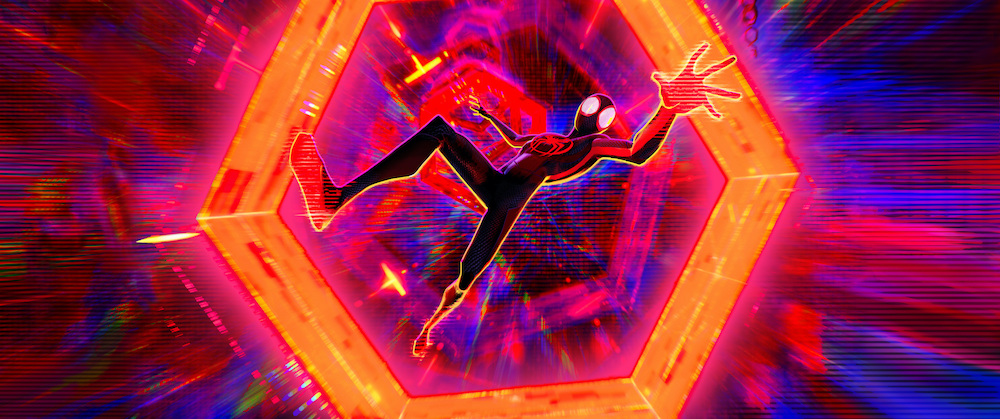
And yet it did make me pick up my jaw from the floor by the end of the screening. As the screen turned black, I found myself bursting into applause as enthusiastically in agreement with many others in the room. How is that possible, since part one already won the Oscar, I asked myself.
By sheer weight of substance. From the overload of visual art (emphasis on ART) – to an eargasmic playlist of original score and soundtrack, to more than two hours of sweepingly emotional, exhilarating, nuanced, and grounded storytelling that just puts many a superhero movie to shame. Puts many films to shame. And yet it remains a superhero movie, without the pretense of saving the real world.
As spoiler-free as I can review Spider-Man: Across The Spider-Verse, here’s how it went.
Flashback. Several years ago, we were introduced to the struggles of New York teener Miles Morales (Shameik Moore) who gets bitten by a radioactive spider that gives him superpowers. Miles witnesses a freak accident involving the Kingpin’s (Liev Schrieber) collider that results in the death of Peter Parker Spider-Man (Chris Pine.) Miles suits up in honor of Peter but in a joke of cosmic-collider proportions, a Peter B. Parker Spider-Man (Jake Johnson) from another dimension appears and eventually shows Miles the ropes. A Gwen Stacy Spider-Woman (Hailee Steinfeld) also appears, as well as several other Spider-people, and they join forces to solve the deal with the multi-dimensions.
Into the present: Miles is still navigating the ropes of growing up into adulthood, including possible plans for college. His parents, Rio (Luna Lauren Velez) and Lt. Jefferson Davis (Brian Tyree Henry) try their best to guide Miles the way they think is best for him.
When the villain Spot (Jason Schwartzman) appears and disrupts the universes, the inter-dimensional Spider-Society led by Miguel O’Hara (Oscar Isaac) intervenes to protect the multiverse. But Miles and the Society aren’t on the same web, so to speak, in terms of dealing with the existential threat. And so, true to himself, Miles decides to do things on his own terms. Whether or not that’s for the best of the multiverse, Miles will just have to find out.
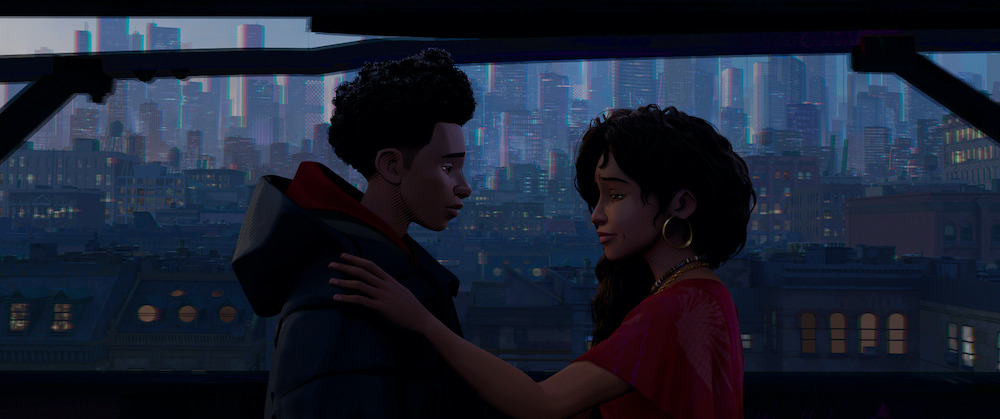
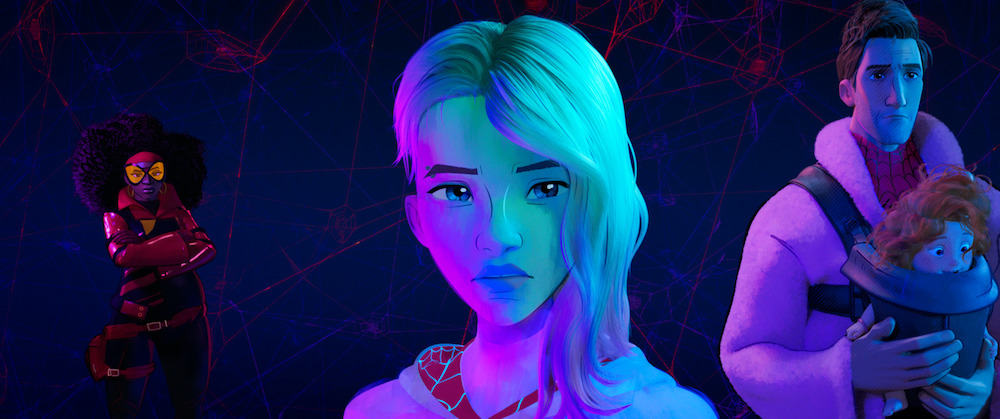
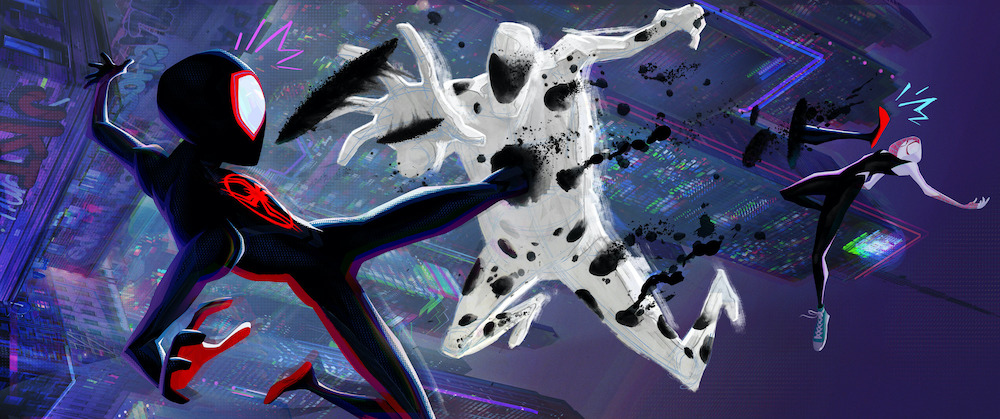


That summary may not sound like much just to avoid spoilers, but the film is overloaded with stuff at two hours and twenty minutes – almost half an hour longer than the first film.
Part Two of Miles’ story retains the thrill of the action, the witty humor, and the exuberance of visuals of the first – and then doubles down on the storytelling. It still whimsically cuts away to the comics each time a new Spider-person is introduced. It’s less about swinging in between skyscrapers and more about tumbling across different dimensions this time.
Whereas Part One’s emotional core ran around Miles’ identity as a teenager who becomes a superhero in a multiverse, parenthood and relationships with friends and family across any universe are front and center in Part Two and are its narrative’s core strength. Rio and Jonathan’s characters are woven even more into Miles’ ever-stressful double life, while Gwen’s thinning connection with her own father George (Shea Whigham) is also given time to further unravel. There’s a family drama in this superhero movie hiding in plain sight amid the stupefying (or overzealous?) display of visuals.
While the first film emulated art styles from the comics in its animation, it seems that the guys from Sony Animation gave Across the Spider-Verse a barrage of visual techniques at their disposal – cartoon, watercolor, poster art, graffiti, you name it – and the effect is just mesmerizing. There’s a particular scene involving Gwen and George that normally in other films wouldn’t need to show textural variance between shots – lighting usually pushes the mood in film. But the scene does just that, enveloping George and Gwen in graphical representations of their disjointedness that’s just artful and almost insane (like in a Mob Psycho 100 OP way or to a lesser degree, the latter seasons of JoJo’s Bizarre Adventure OPs) – it’s art. It’s art up there on the screen.
But as much as I would like to keep heaping praise on its overwhelming art direction, it’s the gravitas of the emotion captured in these frames (by the voice actors, by the music, by the script) resonating throughout two hours of story that astounds. With so much captivating storytelling (and an endless list of easter eggs), it felt like it was a binge-watch of a serious animated series – the type that has densely-packed episodes but is so good it needs to be binged continuously. It’s the type that makes the viewers care for the characters and makes them part of their family (on a daily or weekly basis.)
What more can I say, other than repeat what I’ve said above: once in a while, a film comes along and resets its genre. Call it the Empire Strikes Back or The Godfather Part 2 of the Spider-Verse. I call it amazing in any universe.
Spider-Man: Across the Spider-Verse is directed by Joaquim Dos Santos, Kemp Powers and Justin K. Thompson, with a screenplay written by Phil Lord & Christopher Miller & David Callaham, based on Marvel Comics.
(Images and trailer link courtesy of Columbia Pictures)
 acid reflects
Leave a comment