Survivors of a massive earthquake throng to the last standing apartment complex housing food, shelter and security in South Korea’s bid for the Oscars, Concrete Utopia.
The irony in the film’s title explains what Concrete Utopia is: a hellish parable of the human condition when society breaks down after a world-ending disaster. It is bleak as much as it is stressful to watch.
If South Korea wants an Oscar nomination from this movie, it will come from Lee Byung-hun’s harrowing, unflinching performance as the Apartment leader.
The story is based on Part II: Cheerful Neighbor of the Korean webtoon, “Cheerful Outcast” by Kim Soongnyung (webtoons being the Korean counterparts of the popular Japanese serial mangas – not the artform itself, but as a form of graphic literature. In the Philippines, that used to have been serial Komiks from the 1950s to ’80s.)
Min-sung (Park Seo-joon) and Myung-hwa (Park Bo-young) are husband and wife residents of Hwang Gung (Imperial Palace) Apartments, who find themselves in the thick of the dynamics among homeowners as they organize their survival as a community. A heroic deed earns the trust of the homeowners, and the seemingly timid Young-tak (Lee Byung-hun) is elected Resident Delegate (sort of an association chair or a private district representative.)
The swiftness with which the residents establish their new utopia is impressive (and amusing, in K-drama comical tradition) – but another realization descends upon the homeowners – thrown in the mix among the rations of food distributed by the apartment auntie, Geum-ae (Kim Sun-young) or the medical aid by nurse Myung-hwa, or the neighborhood security led by Min-sung is that of outsiders wanting to relocate to their beloved Hwang Gung Apartments. Homeowners of the concrete utopia tell themselves: only Hwang Gung matters, nothing else, especially outsiders. Myung-hwa would rather save more people regardless, but Min-sung is content with the status quo.
As the resources dry up and the climate freezes, the homeowners become desperate. But more so the people outside their barricades.
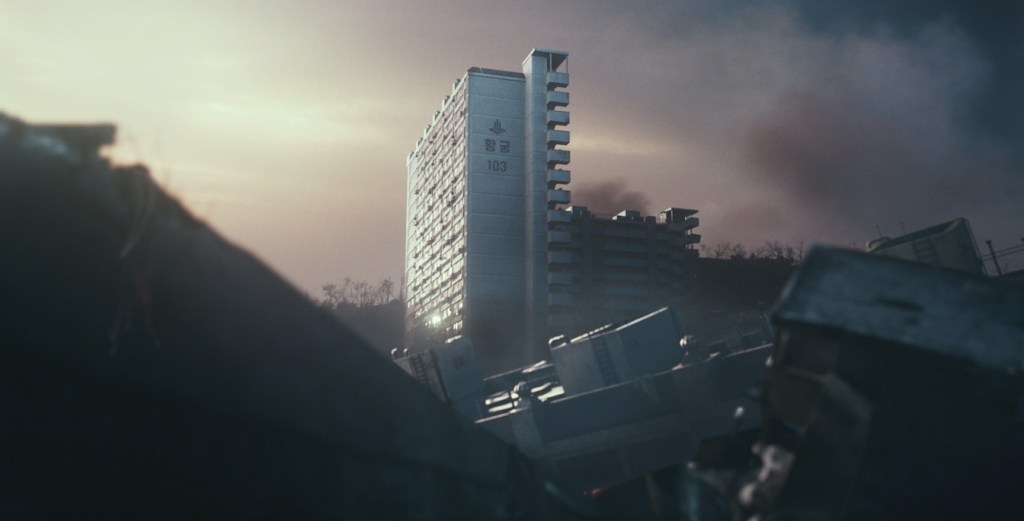



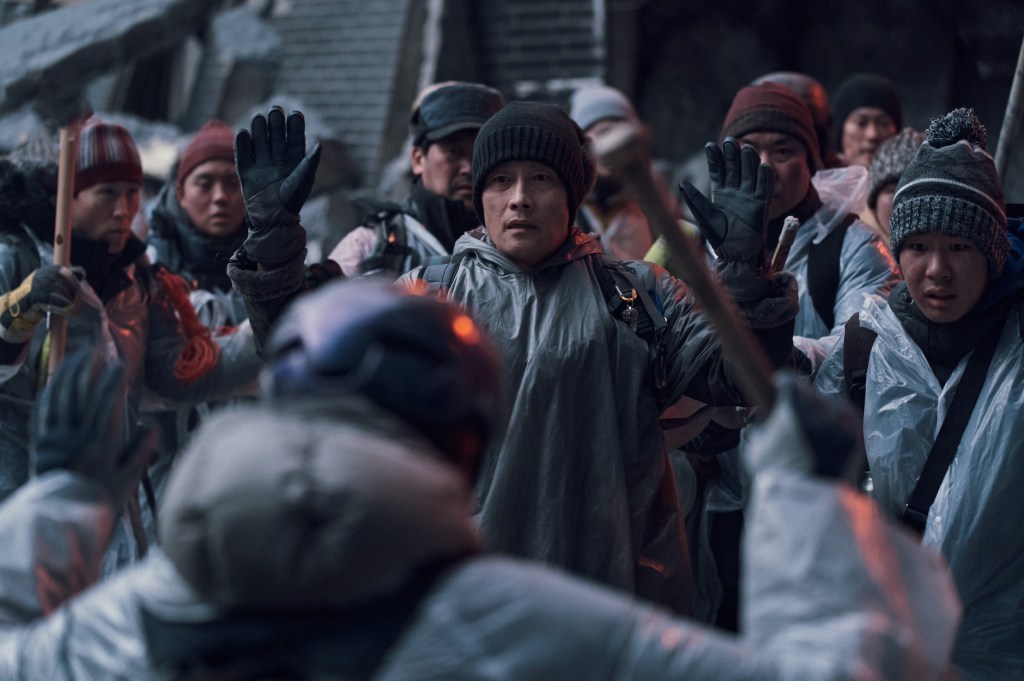
There’s a long list of social issues and symbolism that Concrete Utopia attempts to tackle – I’m unsure if this is due to the source material or completely new from the filmmakers. It’s like Bong Joon-ho’s celebrated Parasite on steroids and mixed with JG Ballard’s High Rise meets Emmerich’s 2012 – class dynamics, ethics of aid, morality, priorities of survival, Korea’s patriarchal, ageist social dynamics, reunification with the economically poorer North, and most of all Christian virtue and salvation – in a dark comedy of hopelessness in a world that’s literally fallen apart.
I find this choice as entry to the International Film category of the Oscars intriguing, as it was a unanimous choice from Korean officials. I found it far from the polish of Parasite (which won an Oscar) and the creeping intensity of Decision to Leave (which didn’t even get nominated.)
(Without spoiling too much, but a slight spoiler.) The film’s morals seem to derive from a pastor’s pulpit, seemingly a cautionary tale for those who refuse to acknowledge the salvation of stained glass light (metaphorically speaking, the church.) I’m intrigued whether it was the webtoon speaking or the writers which portrayed the descent of humans to physical and spiritual hell, and only the meek shall inherit the earth. In short, I find the parable very theologically Christian. Not surprising considering that a good percentage of South Koreans are Christian by religious affinity, according to a recent Gallup poll. I’m not saying there’s anything wrong with it, just making an observation where the story’s values – which speak of morals at a time of emergency – may have come from.
Props to production design and cinematography (and some VFX) that created this bleak world. But the film’s intensity is on the shoulders of Lee Byung-hun, whose journey as Young-tak is as fated as the building itself, whether it stands in the end or not. Lee is the film’s best chance at Korea’s return to the Oscars, if at all.
(Concrete Utopia opens September 20 in Philippine cinemas nationwide, distributed by Columbia Pictures Philippines.)
 acid reflects
Leave a comment