When people acknowledge Martin Scorsese as a true champion of cinema, sometimes there are those who forget that he is also a very prolific producer, a screenwriter of many of his own directions, and at some point, film editor. True, some of those films he helped produce may not have turned out to be as acclaimed as his own films have, but they nonetheless add to the towering totem pole of works throughout his lifetime.
His latest work, Killers of the Flower Moon is no less cinematic despite the Apple Studios tag. Killers of the Flower Moon is a sprawling tapestry of greed, poisonous treachery, and colonial exploitation in prohibition-era Oklahoma as only Martin Scorsese can masterfully put together. Seriously top-notch storytelling, if a bit disjointed because of a key decision in adapting the book. Same old Scorsese, and yet, something artistically new.
The film has some of the hallmarks of a Scorsese film: POV narration, a swath of male characters involved in some form of violence or mobster crime, and a chronicle of a particular point in US American history.
Based on the bestselling novel by David Grann of the same name, Killers of the Flower Moon recounts the series of murders in Osage Nation in Oklahoma known as the Reign of Terror from 1921 to 1926 soon after the discovery of oil in the region, and the investigations that followed that gave birth to the Federal Bureau of Investigation.
Screenwriter Eric Roth’s early version focused heavily on the agents of the Bureau, with Leonardo DiCaprio cast as the agent Tom White who led the investigations. That was the version that studio Paramount Pictures is said to have agreed to make. The subsequent alteration would be picked up by Apple Studios, with Paramount as distributor.
But this is where Scorsese veers off Grann’s crime thriller which parallels the deaths in Osage with the birth of the Bureau. In the middle of script re-writes which DiCaprio reportedly sought, Scorsese and his team flew to Oklahoma to meet with representatives of Osage who sought to put their story upfront and not as mere backdrop as Hollywood usually does with indigenous peoples.
This story revolves around World War 1 veteran Ernest Burkhart (DiCaprio) who is lured into Osage by his businessman uncle, William Hale (Robert De Niro) at first to serve the wealthy of the region, but eventually into marriage to one of Osage’s wealthiest daughters, Mollie (Lily Gladstone.)
Some context. In 1923, the height of the Osage oil boom, the Osage tribe earned more than $30 million in revenue. Under the Osage Allotment Act of 1906 all subsurface minerals within the Osage Nation Reservation (present Osage County, Oklahoma) were tribally owned and held in trust by the U.S. government. Osage mineral leases earned royalties that were paid to the tribe as a whole, with each allottee receiving one equal share, or headright, of the payments. A headright was hereditary and passed to a deceased allottee’s immediate legal heir(s). One did not have to be an Osage to inherit an Osage headright.1
The new script lays most things bare: cattle rancher Hale, who fancied himself as King of the Osage, advanced his political and business influences by portraying himself as a friend to the Osage people – and Burkhart was in on the ruse to take as much money as they can from the Osage through crime or the above-mentioned headright. What wasn’t in the plan was Burkhart actually falling romantically for Mollie.
The film dives into Burkhart’s and Mollie’s relationship at length, which becomes the emotional core of the film. It should be pointed out, however, that this is the film’s take on the matter. That the film early on establishes outright or implicit Hale’s hand at manipulating events in Osage to his gain including everything that happened to Mollie’s family makes the romance suspect at the least. Maybe just one of the few kinks in the otherwise logical proceedings of Roth’s screenplay.
If this were a procedural, the entire film is the flashback where the criminal confesses how things happened – except a good portion comes from the victim’s perspective. It delves deeper on how the unfolding crimes and the encroachment of non-natives were affecting the Osage people – their culture, their traditions, their physical and mental health – and less about the gruesome details as in a true crime tv special.
But the flow is languid, not frenetic like Gangs of New York or jacked up like Wolf of Wall Street. It is akin to The Irishman – not surprising since some of Scorsese’s creative crew from that production also worked on Flower Moon, such as editor Thelma Schoonmaker and cinematographer Rodrigo Prieto.

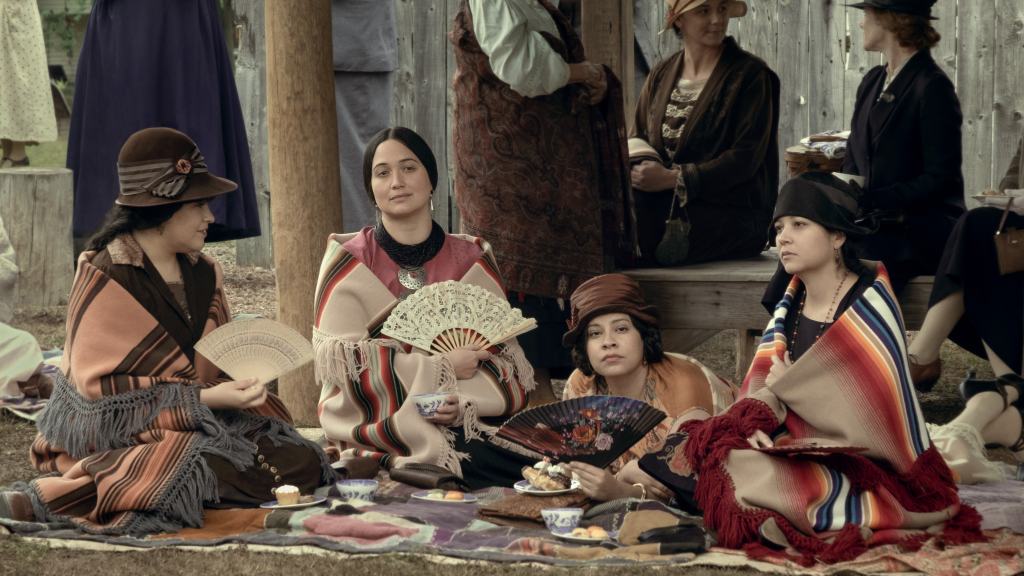
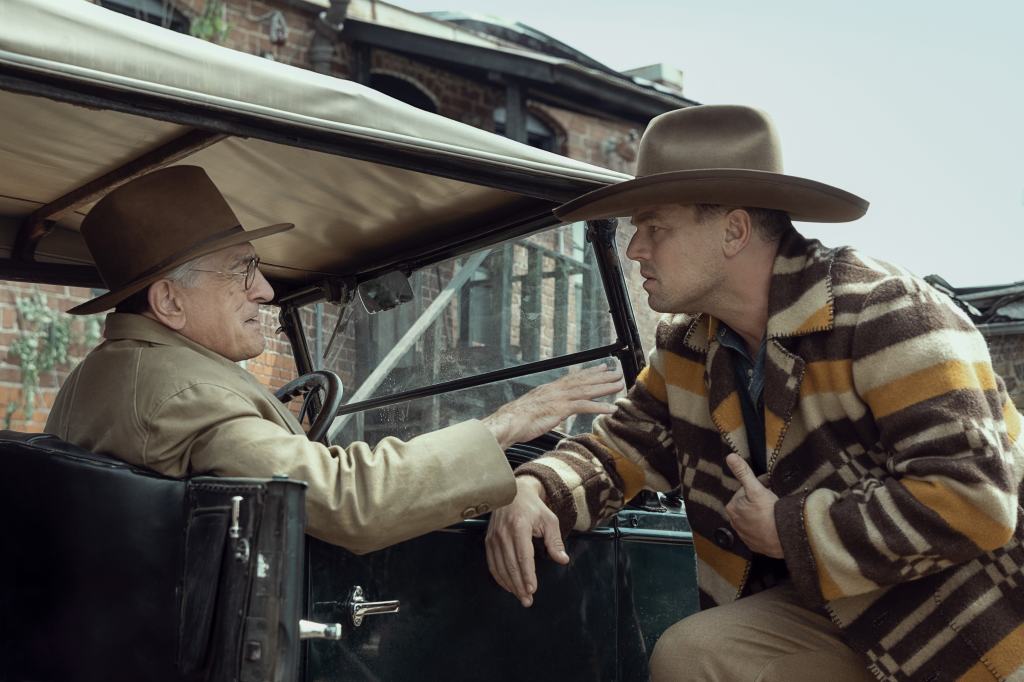
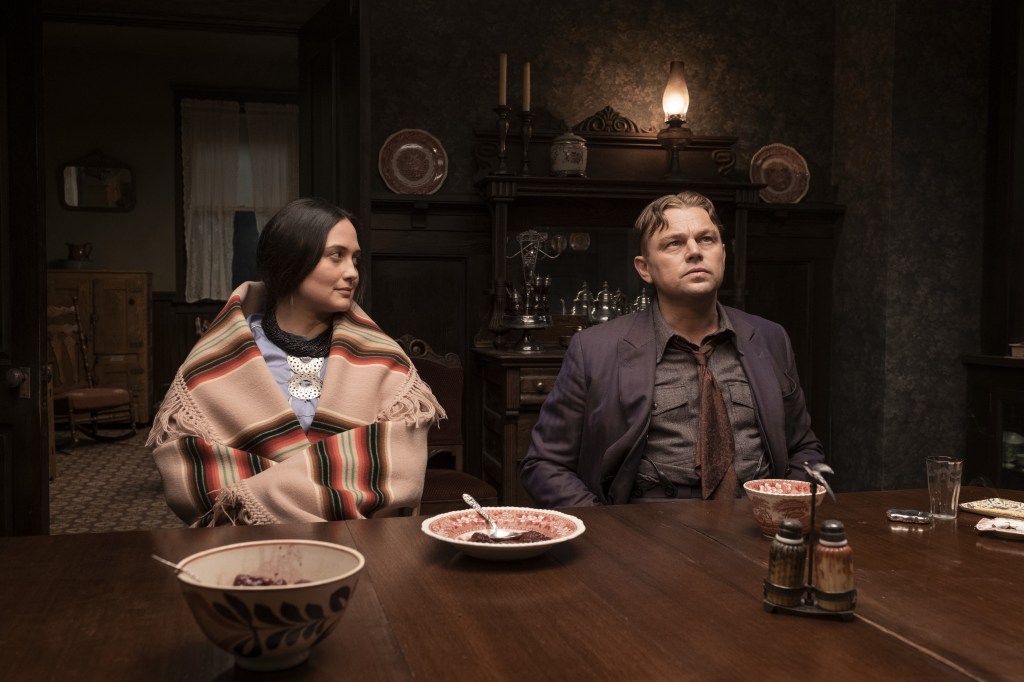
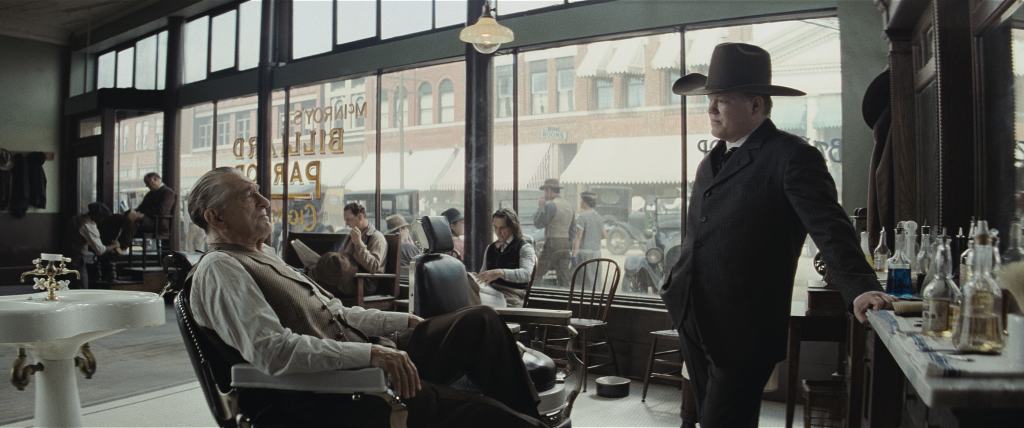
These recent Scorsese films were about The Hunt. Of men hunting for their victims. About alphas hunting for their prey.
Scorsese was probably conscious of this during the re-write since the film turned its back from being a complete procedural. At one point, Mollie tells Ernest to quiet down during a thunderous storm. And sit quietly, they did. The Scorsese of Goodfellas and Wolf probably would have cut away to a quick B-roll montage, but the Scorsese (and Roth) of Flower Moon chose the Osage way of listening to the earth without a word, even for a moment. Mollie even gets to voice narrate a short part in her story – is that rare for a Scorsese film? At last, an alpha female lead from Scorsese.
Gladstone is a marvel to watch, her ‘no-acting, please” performance commands attention in every frame she’s on, her words heavy with weight even if she’s whispering due to the disease ravaging her body. DiCaprio’s Burkhart is a mixed bag for me, likely because Burkhart was being duplicitous with the Osage and Mollie, and with DiCaprio doing what felt like improv exercises in some of his scenes. I pointed this out to a companion at the local press screening, and this was validated by a quip from Scorsese from this report from Variety. While the rest of the cast can be commended for their performances, Gladstone’s is without a doubt unforgettable.
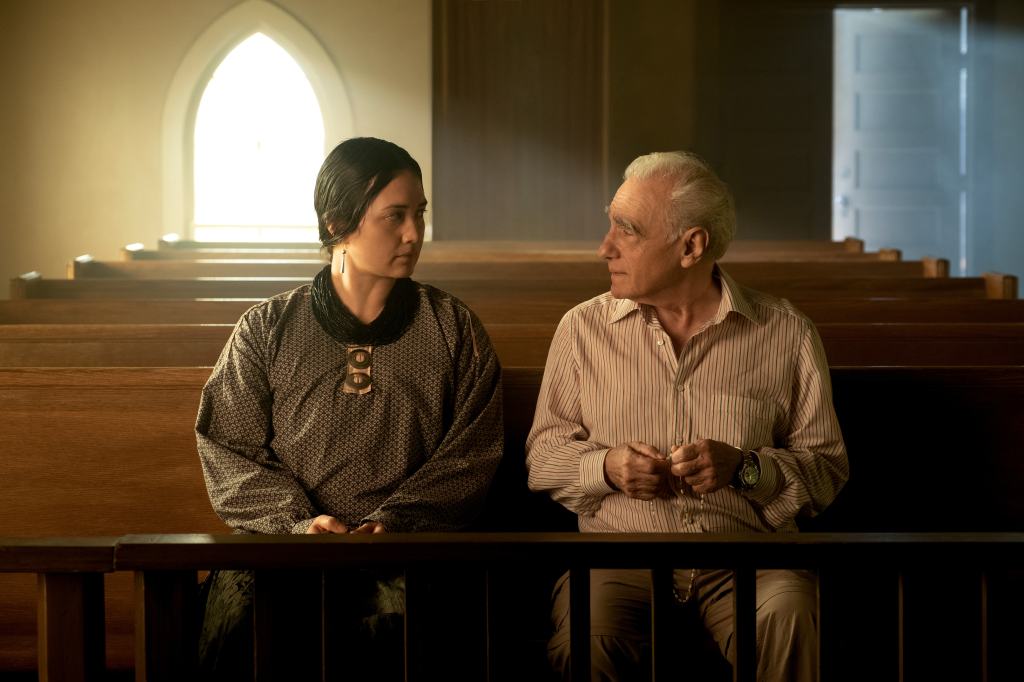
By the time the film wraps up, it is back in standard FBI courtroom drama as the investigation pins its case against the perpetrators (with a hefty surprise cameo acting as defense attorney, to boot.) Burkhart and Mollie share one last heartbreaking scene together before it finally ends with the Osage.
In truth, what happens to the Osage is much more tragic than how the film ends. It’s a little weird that at the end of the film, the viewer would have felt the accomplishment of seeing another Scorsese film, instead of maybe feeling a lot more for the people of Osage (quite unlike, say, the end of Schindler’s List as the credits rolled over gravestones turned into pavement, one wanted to turn back time so the Holocaust would have been avoided. Or something to that effect. An upsetting feeling. Or anger.) The feeling is there in Flower Moon, maybe not just as intense as I would have imagined.
(Images and trailer link from Paramount Pictures)
————-
1 From Oklahoma Historical Society Osage Murders
 acid reflects
Leave a comment