This film had me thinking all throughout the screening. Historical accuracy aside, I was expecting full-on battle spectacle from what was being sold as the story of a military conqueror. Not only did we not get that, we also didn’t get a full-on love story between self-crowned emperor Napoleon and his wife, Josephine. Such oddly nitpicked choices of historical moments.
Pourquoi, pourquoi.
We can’t rightfully call it a biopic, I think, as the film is rife with inaccuracies. Ridley Scott himself has spoken about the matter (or its lack thereof.) Some early review already quipped that Scott’s Napoleon works best as a comedy – to which I agree – but that would make this the most extravagant History of the World spinoff if it were Mel Brooks at the helm.
So what – or who – is Napoleon?
The film is a loose retelling of the Corsican who quickly rose to military power in the aftermath of the French Revolution to become one of the most infamous and influential figures in all of human history. Joaquin Phoenix – described here in Owen Gleiberman’s Variety piece as a one-man cult of depressive method acting – provides a aloof, often confusing, portrayal of the emperor Napoleon Bonaparte probably due to the way the story itself is confused how to present the figure. General? Tyrant? Man-child? Romantic? All of the above but mere snippets of each.
Sometimes, a voiceover is heard apparently reading letters sent to and from Bonaparte. The letters wax poetry and pining, sometimes unexpectedly in places to interject emotion. I can’t deduce if this was a device or leitmotif, as the voiceovers supplant the narrative’s lack of emotional journey rather than adding to the already historically inaccurate story. More on this later.
SPOILERS AHEAD PLEASE BE WARNED.
SPOILERS AHEAD PLEASE BE WARNED. (Then again, History?!)
The film begins with Napoleon supposedly witnessing the public decapitation of Marie Antoinette at Place de la Révolution. It’s a big scene with hundreds of extras and a bombastic Edith Piaf rendition of the revolution’s theme, Le “Ça Ira” befitting the immensity the tumult would impart to the world. As a point in the story, this instance would prepare the audience to the irony how eleven years after the revolution, the French – through Bonaparte – would return to authoritarian rule. Not an historically accurate scene, but signifies where the epic is heading (Oh no! A pun.)
Napoleon is recruited to captain an artillery force in Toulon (the name reminded me of Les Misérables) to force the occupying British who were then aiding the Corsican secessionists to leave the harbor. Victorious, Napoleon’s loyalty to the republic over his native Corsica earns him the rank of brigadier general at age 24 (Sorry to the makeup team [or de-aging team] but Phoenix hardly looked young here.) This is like four separate historic events but is condensed into a single sequence. Of course I did my homework before the screening.
Back in the capital, royalists who wanted a return to monarchial rule stage a revolt against the constituent assembly (“congress.”) The revolt shown here doesn’t seem to be a large, bloody protest, but implied to be so. One of the notable politicians, Paul Barras (Tahar Rahim) recommends that Napoleon command the defense of the assembly’s convention happening at Tuilleries Palace. On Napoleon’s cue, the protesters are mowed down by canons, guts and limbs flying everywhere. Bonaparte is celebrated a hero of the Republic. *Cliffnotes for Authoritarian Rule.

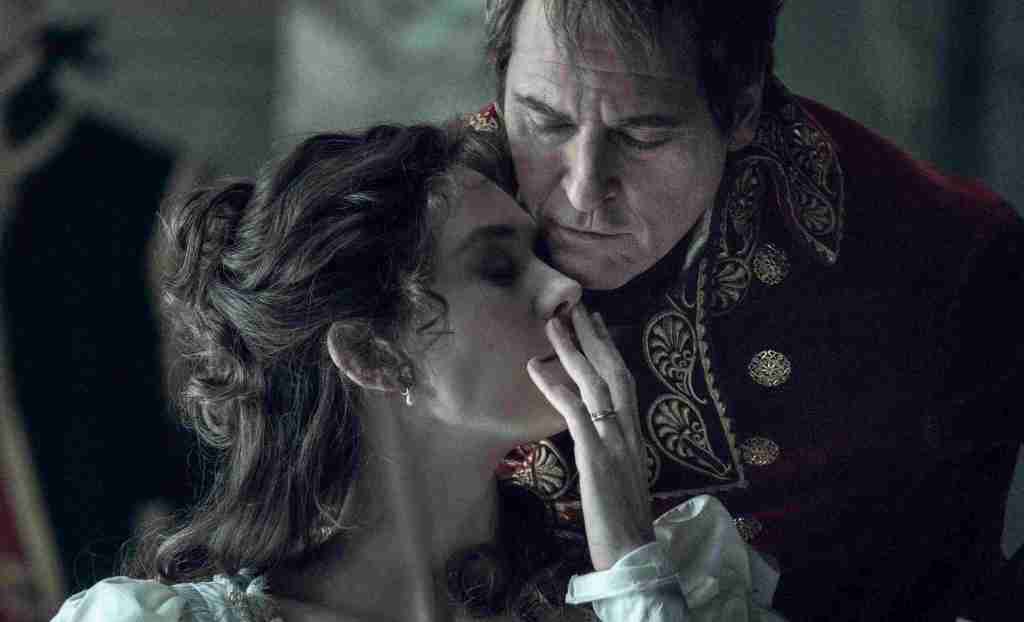


Promoted to Commander of the Interior and the Army of Italy, it was hereafter that Napoleon met his dearest Josephine (the magnetic Vanessa Kirby.) (The film ditches historical account that the widow de Beauharnais went by her name Marie Rose and that it was Napoleon who gave her the name Josephine, after her father Joseph. I thought this historical fact would put an interesting tidbit to the dynamics of the two, but the film would explore otherwise. Screenwriters = 1, Me = 0.)
Josephine here is a seductress, an enchanting modern French woman who is too sophisticated to the socially awkward Napoleon. So much so that she flirts with a French officer soon after her whirlwind marriage to the general. Kirby’s Josephine is electric, instantly wrapping Napoleon around her experienced finger in no time.
Not yet confident to fight against the mighty British Royal Navy, Napoleon heads to Egypt to cut off British access to Indian resources. He is successful, and it is during this campaign that Napoleon learns of Josephine’s affair(s.) He sails back to France pronto, to arduous public reception, though Page Six of the papers are headlined on page one. Mummy’s accursed.
We’re not even near halfway through the film.
The next sequence is part two of quizzing the viewer where the story goes.
Domestic spat ensues, wife’s luggages thrown out onto the lawn. Napoleon demands submission (“You are nothing without me,”) but Josephine, the adult in the bedroom, turns the conversation around and tames the general who then admits, “I am nothing without you.” I gasp in my head: are we getting a love story? is this a case of “who emperors the emperor”? Where is this film going? Time jump or edit discontinuity cure: infidelity from both parties are admitted, shocker.
The next scenes are again shortcuts of Napoleon’s rise to power.
Dashing aside the accusation of deserting his soldiers in Egypt, Napoleon allies with a small group led by his brother Lucien (Matthew Needham) and Talleyrand (Paul Rhys) to stage a coup d’etat and overthrow the ruling Directory in another comically staged sequence. Big scene, cast of a couple hundreds. Napoleon becomes First Consul in the arrangement, but effectively sits as king.
Bonaparte then seeks alliances against the coalitions of Austria and Britain, first with the Russian Tsar (a young Tsar Alexander, played by Edouard Philipponnat.) The scene with the British consul is again interesting: in a fit of military jealousy, Napoleon blurts out a line worthy of SNL parodies. Phoenix sells it so well, his comedy impeccable that, once again, I wonder: should this film have been made a satire from the beginning?
A quick pumping of raunchy scenes later where Napoleon seeks an heir, and then Napoleon’s and Josephine’s next appearance is the majestic coronation, truly a grand spectacle by itself, replicating the grandeur of Jacques-Louis David’s oil painting, The Coronation of Napoleon. That’s a sight worth seeing on a large screen.
If by this time you, who were told that this is a Ridley Scott action film, are wondering where the battles are, I was wondering, too.
In answer, the next scene is The Battle of Austerlitz, which is supposed to be one of Napoleon’s biggest victories in the conquest of Europe, one that cemented his status as a military tactician. The French army would defeat a large regiment of tens of thousands of Russians and Austrians. While beautifully photographed in snow and even in the dark, the sequence is somewhat a let down, barely building up tension. Military historians probably would know more if the scene depicted Napoleon’s strategy accurately, but as a highlight of the film it lands on a thud. For me, at least. Screenwriters = 2, Me = 0.
Lacking an heir, Napoleon forcibly divorces Josephine to wed the very young sister of the emperor of Austria (played by Miles Jupp) Marie Louise (I couldn’t find her name in the credits.) For the first time in the film, we hear Phoenix speak French, to utter the word “petite” while speaking with Marie Louise’s actor. Marie Louise would soon bear a son to Napoleon, who, for whatever reason, brings the child to Josephine.
Every now and then, the voice of a character is heard reading a letter. Usually it is Napoleon, sometimes Josephine but not necessarily to each other all the time.
The following scenes would summarize Napoleon’s quests, as he leads his army to an emptied Moscow. In a case of tell and tell, Napoleon declares onscreen: “300,000 souls lived in the city, and they’ve all just left?” It is The Russian Winter. Voiceover reading of letters between Napoleon and Josephine continue. They’ve been separated at this point, haven’t they? By this time, it is obvious that the letters convey the emotional weight Napoleon is supposedly carrying in his battles, a script device to shorten what otherwise would have been additional scenes depicting Napoleon’s inner demons (if he had any.)
The victory – at the cost of thousands of French soldiers’ lives – sends Napoleon to exile in Elba. However, after some impatient time on that island, Napoleon musters enough loyal guards to return to Paris and retake his throne, albeit for a brief period.
The Battle of Waterloo. Napoleon’s ultimate challenge to defeat the British army, led by the Duke of Wellington (Rupert Everett.) This entire film about one of history’s greatest military generals climaxes in the character’s biggest defeat. This is the battle we’ve been waiting for from the beginning, as it is just one, albeit his last, of Napoleon’s many wars. It is almost thrilling, if only I cared for characters. I wish the battle in Austerlitz was as grandly staged as this parting shot.
I hardly felt anything for the characters in the film. As I have kept wondering why certain moments in French history, in Napoleon’s wars, in his relationship with Josephine were either kept or withdrawn. What thesis was Scott pursuing with this story? More headlines for Page Six?
- a) Fierce warlord a horny teen in the bedchamber?
- b) Napoleon & Josephine: The Love Letters, sexting across the Empire
Where’s the tyrant who pillaged and burned? The advance of science and education? Josephine’s extravagant life? Napoleon’s adoration of Josephine’s children to her first husband (who were instrumental in keeping their relationship last as long as it did)?
Two and a half hours couldn’t have been enough, having expected Ridley Scott -masterplanned epic battles but seeing so few. Plus a better written female side character, who usually are strong survivor characters based on Scott’s filmography. Where’s the ass-kicking female?
That said, it does work best as a comedy, having demonstrated this in a few outright funny scenes. How funnier could it have been if the film had more deadpan jokes? On hindsight, that would have turned this show British. Napoleon spoke with a North American accent, most of the actors playing French had British accents, the first subtitle appears over Austrian dialog, and the one word Napoleon says in French is “petite.”
With accuracy out the window, the fewer-than-expected battles barely make up for the grocery list of milestones ticked off by the script, as if the film was just an endless series of curated historical vignettes following a choppy timeline. I was not expecting extravaganzas as awe-inspiring as Lawrence of Arabia a la David Lean, nor as huge as the 12,000-extra, seven-hour swath of 1966-67 War and Peace by Sergei Bondarchuk. In the age of expansive IMAX screens, Scott’s panoramas seemed limited (this may be a function of the eventual small-screen streaming release.) But if we are to use words to describe things as “epic,” they should be worthy of it. I didn’t get a “wow.” More like “mmmkay.”
Maybe a Napoleon & Josephine romance would be an intriguing exploration by the longer streaming version. Maybe that could align closer to historical accounts, with Josephine playing a bigger role in the power-play amongst the elite while Napoleon was just on the rise. That was supposedly the meaning of putting her in the middle of the Coronation painting. A kind of Imelda to Napoleon’s Marcos if dictators were to be compared – although Imelda would have been a mere shadow to Josephine’s extravagant lifestyle (this comparison wouldn’t have been the first, read Gregory Jensen’s Notes from Josephine here.) Although, again, should the extended streaming cut decide to further romanticize this conjugal rule, the Marcoses were ahead by more than half a century, having produced the fairytale biopic Iginuhit ng Tadhana (Drawn by Fate) about then Senator Ferdinand Marcos and the love of his life, Imelda, played by Luis Gonzales and Gloria Romero respectively. The film was released during Marcos’s presidential campaign in 1965. We Filipinos invented historical inaccuracy. Needless to say, Marcos won.
Looking forward to Napoleon’s extended cut on AppleTV+, which should have more meat in the bones. It looks grand and gorgeous at least.
Hopefully Le “Ça Ira” (It will be fine) indeed.
(Images and links courtesy of Columbia Pictures)
 acid reflects
Leave a comment