I certainly wasn’t expecting a story about life and death as my first review after recent events in the family.
For the past few weeks, I had been grieving, along with the rest of the family, for the loss of our mother and one of our siblings whom we both lost only two weeks apart. So it was a bit of a surprise and a pinch that Mamoru Hosoda’s latest project felt to me more about a rumination on life and death rather than a tale of revenge and forgiveness as was the film’s Shakesperean inspiration, Hamlet.
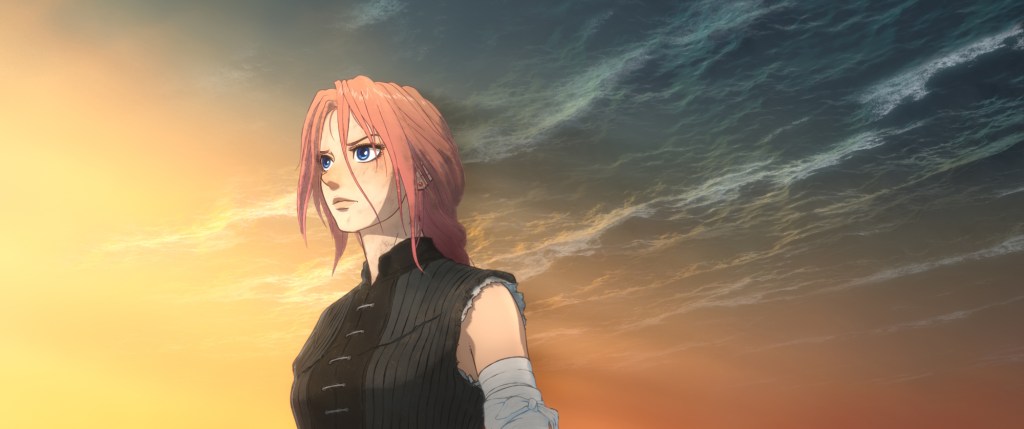
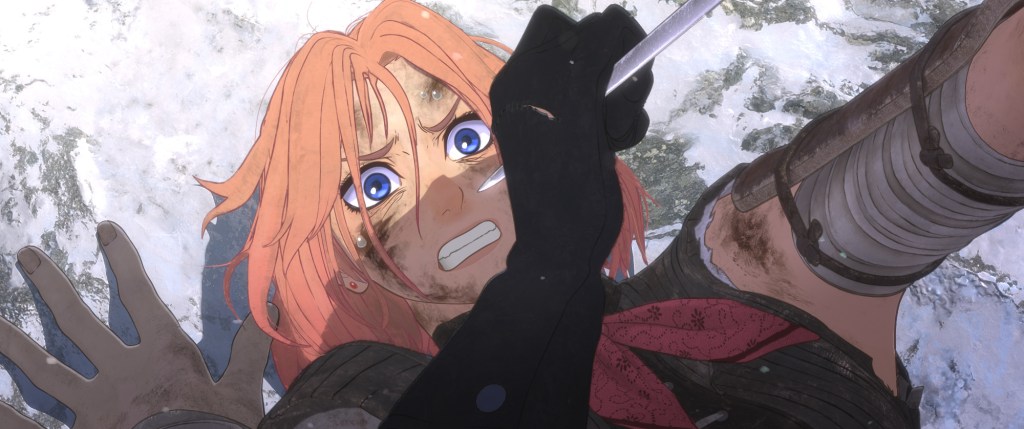
The film begins in the Otherworld – that space between life and death that is also beyond time – as a grown Scarlet (VA Mana Ashida) struggles to break free from the grasp of a hundred hands of death, vowing to exact revenge for her slain father, whether she does it alive or in the afterlife.
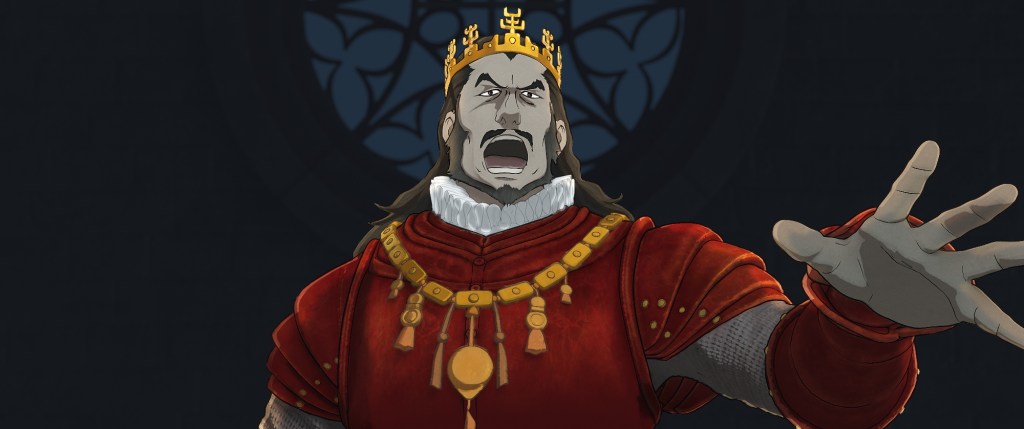
Rewind back to medieval Denmark where this tale begins, where beloved king Amlet (VA Masachika Ichimura) is killed by henchmen after a coup by his own brother, Claudius (VO Koji Yakusho) and the queen (VA Yuki Saito), who were having an affair. Scarlet, the only royal child, is spared (for whatever reason) – but the young princess promises herself to avenge her father.
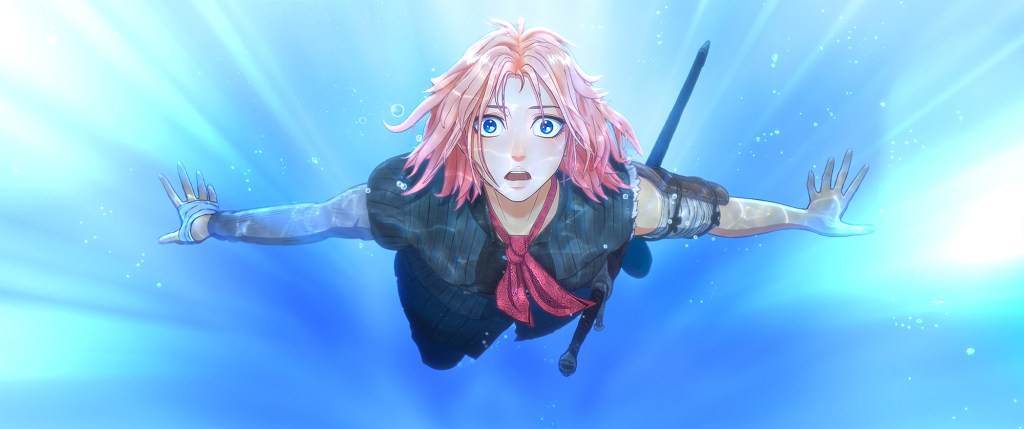
After some years of combat training, she makes an attempt to slay her father’s murderer at a banquet. Her naivete getting the best of her, Claudius points out, as Scarlet falls from a poisoned drink. Which brings us to the beginning of the film.
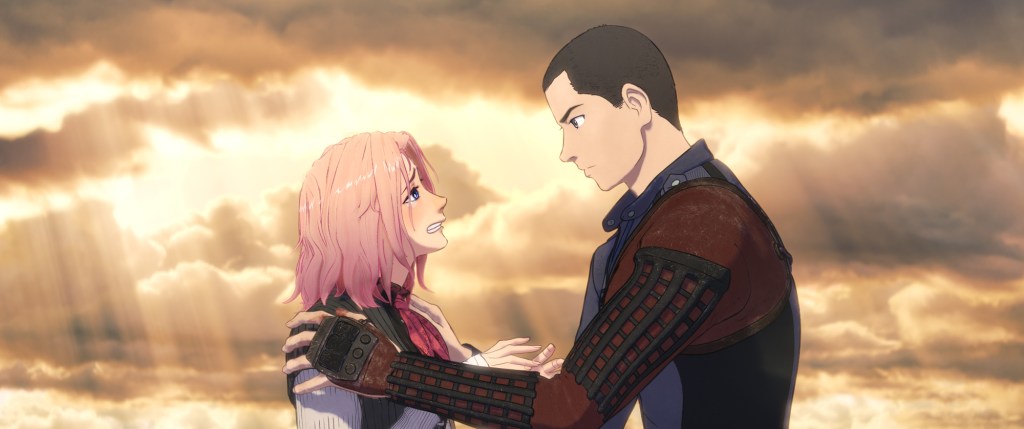
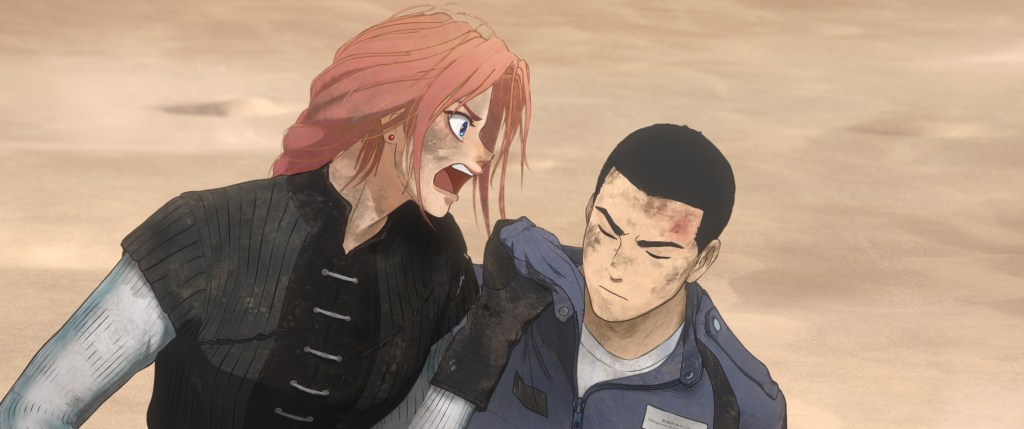
Scarlet breaks free the hellish hands grasping at her, and begins to search for a way to go back to her kingdom – only to be told by other souls that her uncle, too, has died, but is building his own kingdom in the Otherworld. She ventures off to find Cladius’s otherworldiy stronghold, occasionally fighting off his soldiers one by one. Quite soon along the way, she meets a curious young man who introduces himself as a paramedic. Hijiri (VA Masaki Okada) doesn’t believe he is dead since his purpose is to heal the wounded. They make an odd couple crossing vast distances together, often disagreeing that their pursuits to peace were completely opposite from each other. One believes that revenge will grant her soul peace, the other believes that acceptance of others grants peace.
One night as they camp out together with a diverse collective of travelers, Scarlet sees a vision of an alternate life of happiness set in Hijiri’s time. When she wakes from this vision, she asks Hijiri if she could have lived differently (from a life built on revenge) had she been born at a different time. This line hit me, as it reminded me of my brother’s unfinished life that was cut too soon. I wondered if he could have lived a fulfilled life had he been born at a different time and place, a better one than what he was given in this universe.
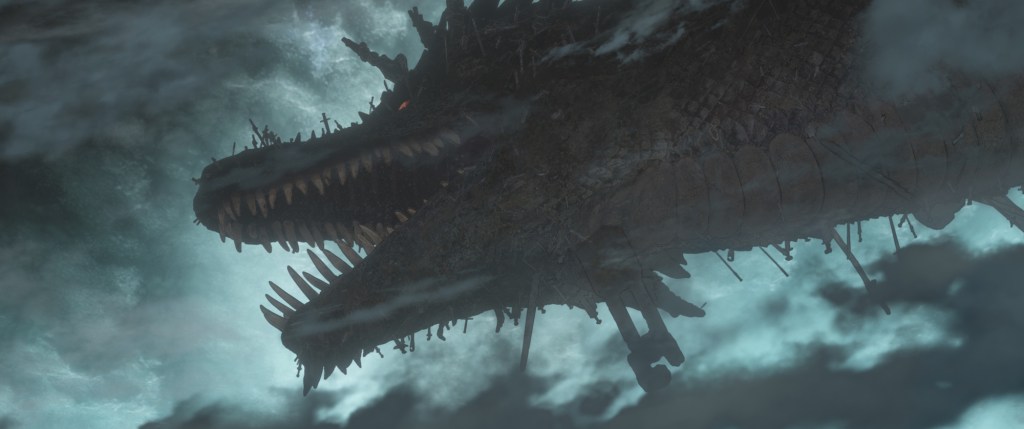
When Scarlet and Hijiri do reach Claudius’ stronghold, it’s a mad dash towards the gates of paradise along with hundreds of thousands of other souls gathered at the foot of Claudius’s castle. The narrative takes a chaotic spin from this point onwards. Scarlet meets Claudius at the gates to paradise, and the two spar with sharpened voices – conscience versus purpose, anger versus understanding, revenge versus destiny. Ultimately, the roar of the draconian universe metes its thunderous justice after Scarlet disowns the hatred inside her. This film preaches peace at a time (whether in Scarlet’s or ours) when uncertainty and disasters spell war and suffering, and forgiveness as the path towards enlightenment.
I have a disagreement with this worldview. I dare not say that this path has no merit, but in today’s time when tyranny and fascism are spreading across the world, seeking accountability is the just way for peace, There can’t be forgiveness without acknowledgment and repentance.
Denmark, Amlet, Gertrude, Claudius, “frailty, thy name is woman” – quick-eared fans and students of the Bard can easily recognize the reference to Shakespeare’s Hamlet – although the source material hits harder with darker scenarios of revenge, conspiracy, insanity, and death.
Hosoda takes a different path for his version of Hamlet – one that involves a journey through the underworld as a path towards salvation (or resurrection. Hosoda often merges various themes in his adaptations, either to sublimate or alter the text of the source, as in the case of his most recent before Scarlet, Belle (2021.)
Belle was a loose musical adaptation of Beauty and The Beast – replete with a version of the infamous 3D ballroom dance that wowed audiences of the Disney animation and a public storming of the castle led by a misguided, haughty soldier not too different from the Disney Gaston. But Hosoda’s tale provoked questions on identity and truth at a time of digital (artificial) personas. His Belle was the story of a young student who could only find acceptance as a beautiful singing avatar in a digital universe – not so different from the virtual worlds that we today populate. As a side story, Belle even took a shallow dip into the world of child abuse and parental overreach – hot topics even in today’s still-patriarchal Japan.
Scarlet, by journeying through the underworld, questions life and death with religious undertones. Can we truly rework our karma if reincarnation is granted? As this question crossed my mind, I wondered if my mother’s and brother’s souls would be granted new, more fulfilled lives than what they had gone through, no matter how much love our family (thinks) had showered their way, considering all circumstances.
It’s not an accident that Hosoda presents a diverse population of cultures in this version of purgatory, even including a musical number involving Pacific islanders (not sure if Hawaiian.) Hosoda wants to ask (naively, to me at least) a universal question: is the pursuit of peace (internal or wartime) attainable through forgiveness? It sounds like a Bhuddist question, even though forgiveness is central in Christian belief. Not a surprise, again, as the name Hijiri – that person in the story that constantly tames Scarlet’s anger – simultaneously translates from Japanese to healer, a holy man, (and the symbol) to the Christian Bible. Minus this exploration, Scarlet’s revenge plot comes off as a thin storyline.
From an animation perspective, Hosoda has mastered the merging of 2D hand drawn images with the 3D movements of CGI, something he has been doing since his most famous piece, The Girl Who Leapt Through TIme (Toki o kakeru shôjo) in 2006. Artwork and lighting swing from painterly lush to stunningly realist, but the magic is when the camera moves to add dimension to these images. Two sequences are particularly impressive: an action-packed sword fight while mounted on horses, and that tropical paradise of thick jungle leading to the heavenly gate. The fight scene impressed in how the camerawork made the hand-drawn elements move in a virtual 3D environment, the jungle impressed by sheer photorealism.
As a side note, Hosoda often gives his characters wide-eyed, open-mouthed, jaw-dropped expressions multiple times in one movie. Scarlet and Hijiri did this a couple of times; Makoto (in The Girl Who Leapt Through Time) did, Suzu and several side characters did this in Belle; Hana did this a lot in Wolf Children (2012.) Maybe this is Hosoda’s way to indicate how the world is often full of surprise. Or maybe the expression just happens to occur very often, as his stories always include a twist or two.
Another curiosity: in a sea of character realism, Scarlet’s head and face is designed to subscribe to anime conventions: that is, her face is shaped like that of a cat. The rest of the charaters in the film have a realist shape to them (the only other possible exceptions are the faces of the random girl and the Mystrious Old Woman narrator.) Not fond of the musical scoring, as I find (personally) Hosoda’s films just a tad too overscored. Maybe it’s just a sound mixing thing.
Stunning visuals, deep story from Mamoru Hosoda. But the revenge story may be too dark for most audiences (but shouldn’t be a problem with regular anime fans.)
Scarlet is showing exclusively in SM Cinemas now from Columbia Pictures Philippines.
 acid reflects
Leave a comment