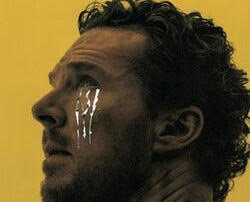
Apologies in advance if the following review would sound ostentatious, but allow me to attempt to understand the perplexing choices made in the making of this film based on my experiences both professional and personal.
I didn’t like The Thing with Feathers at all. To be fair, this adaptation points viewers to go back to the source material Grief is the Thing with Feathers by Max Porter, as the film tried to process grief and despair without any subtlety or notion of depth. I have yet to read the book. Maybe it would be a more satisfying experience.
In The Thing With Feathers, Benedict Cumberbatch is Dad – a husband/father who tries, mostly unsuccessfully, to navigate grieving after the loss of his young wife and mother to his young boys (siblings Henry and Richard Boxall.) Each day that passes, he is reminded of how dependent he was towards his wife who raised their children, and and how he just couldn’t cope with his grief and loneliness. So much so that one night, a giant crow (voiced by David Thewlis and performed in costume by Eric Lampaert) knocks on his window and enters his home to pester his feelings and thoughts even more. Basically that is it.
Over plucked acoustic music, the film starts with Hollywood credits of the production stylized over hand sketches of crows to the tune of plucked-strings music. The screen aspect is in 4:3 – something that belongs to the age of film (movies) before HD screens, but there’s no indication that the story told is a period piece. Maybe it’s about being boxed in?
After the credits, story opens to the toll of a church bell, the fluttering of feathers, and a bird’s crow. Death and crows within ten seconds of the film. It cannot be more literal.
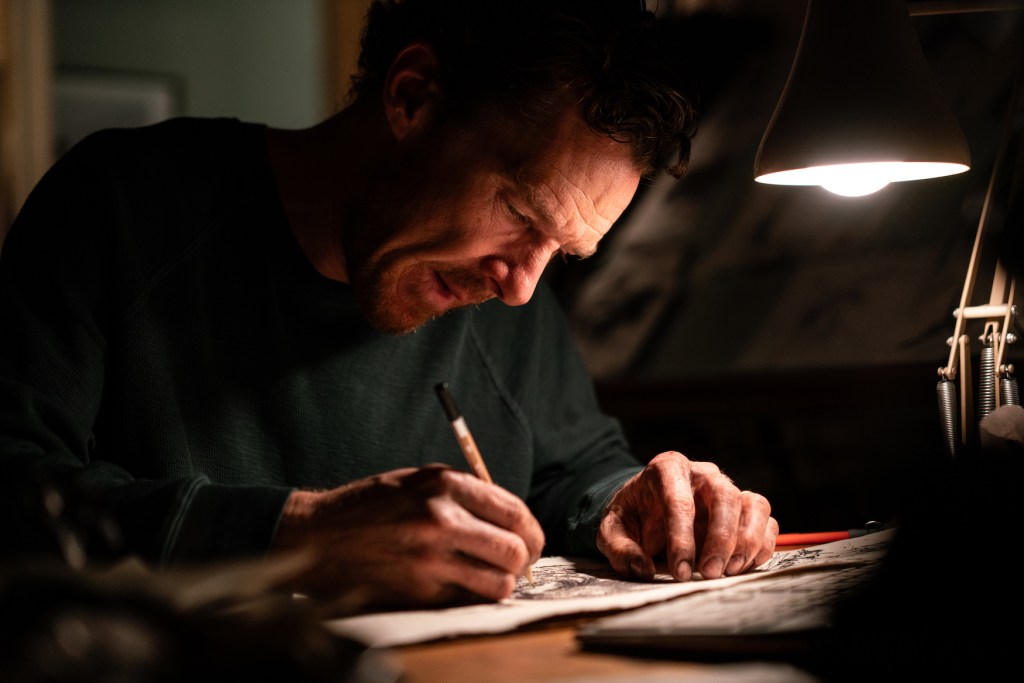
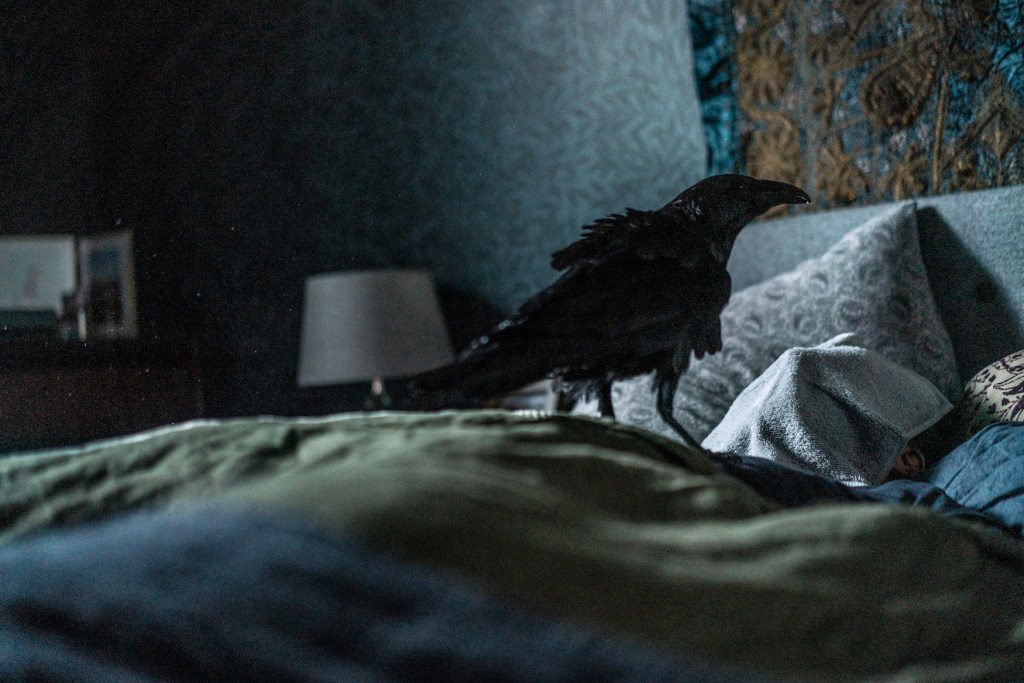
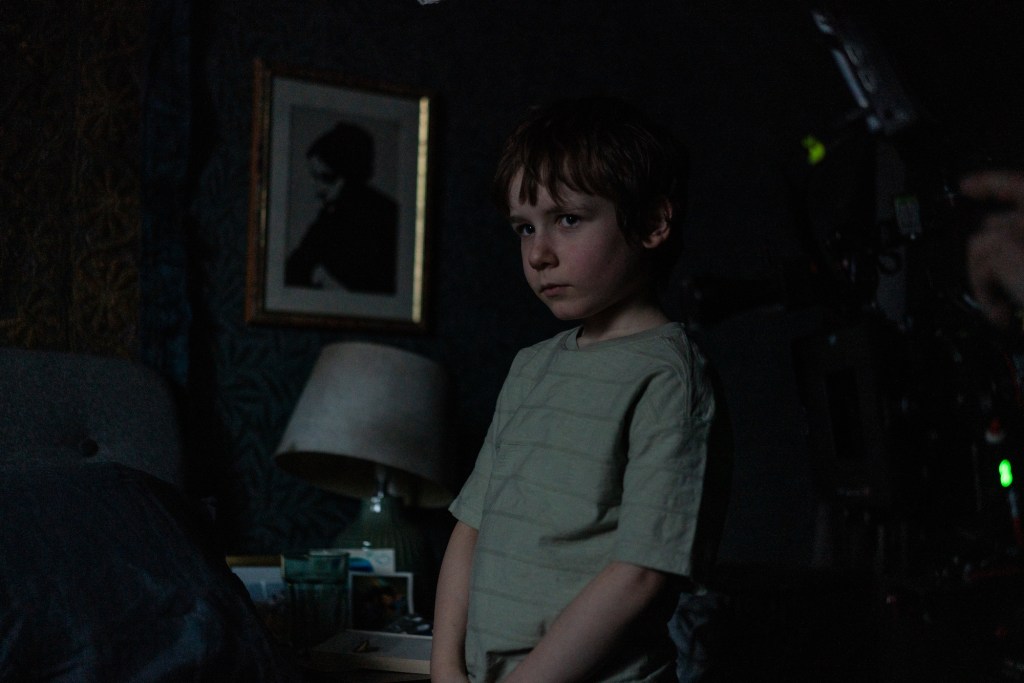
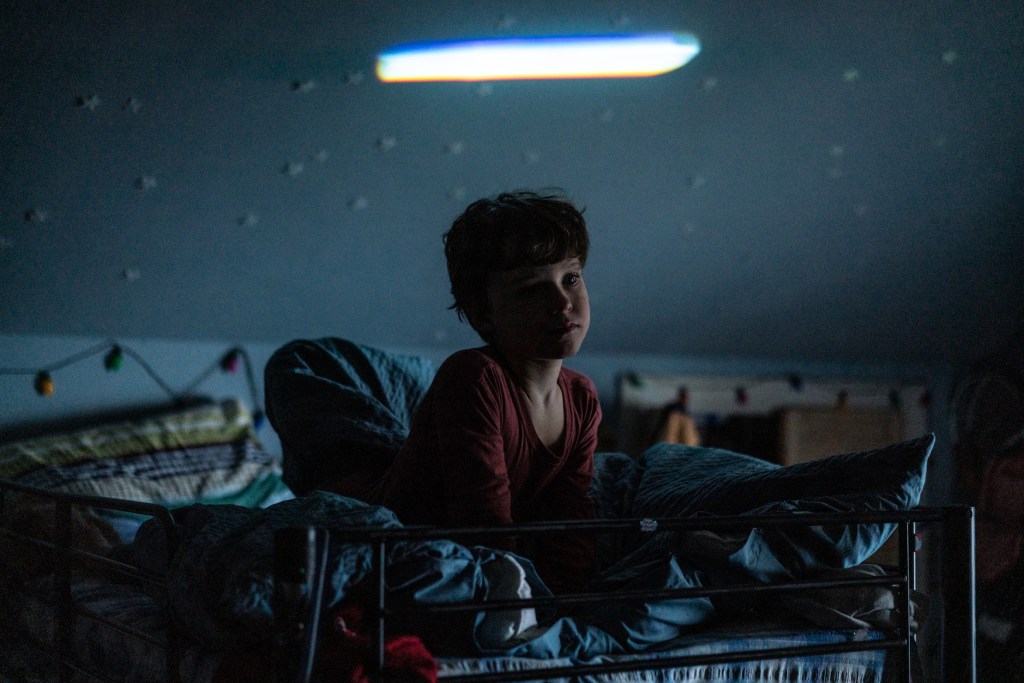
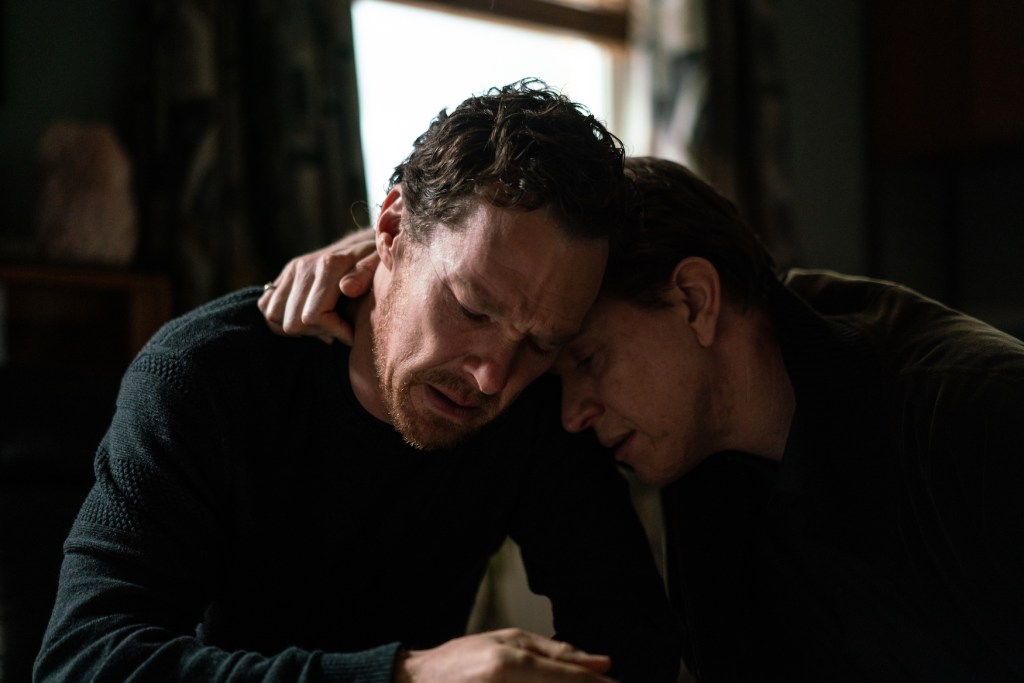
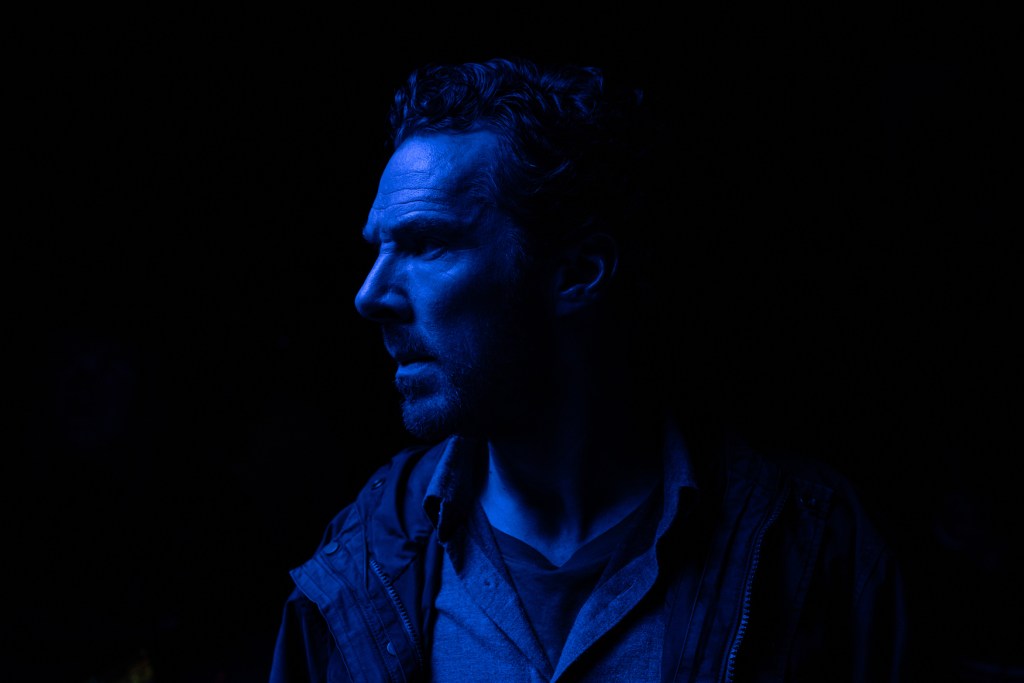
Next shot is that of a boy (Boy 2) sleeping on a sofa. Then a shot of the grieving family from behind Dad, his two boys each on either side. It is right after the funeral, they are all in black. At a time of grief, he is not beside them but distant. So far so good – there’s concision in the way the story is being unfolded, although we’ve barely hit the first minute of the film. Sad Dad does tuck the boys in to their beds, so yes, he cares for them deeply.
Next morning, to the tune of The Cure’s In Between Days, Sad Dad struggles to prepare breakfast to start their day. He doesn’t know where things are, there’s no milk in the fridge, and they boys barely listen to his words. He breathes heavily, pressing his head on the cupboard door – usually a depiction of typical motherhood but now it’s Dad. The subtleties of the previous five minutes are gone, just like that. The film mosty gets literal after this, ironic for a film based on poetry.
Based on the 2015 book Grief is the Thing with Feathers by Max Porter which was inpsired by poet Ted Hughes’ lietrary work Crow: From the Life and Songs of the Crow (1970) (futhermore, the title is the mirror opposite of the poem Hope is the Thing with Feathers by Emily Dickinson) director Dylan Southern’s film is an exploration of grief and acceptance by a father and his children who just suffered a devastating loss. An Irish stage adaptation was done in 2018 by Enda Walsh starring Cillian Murphy.
The first half is tonally horror – “grieving widowers and motherless chidren are pure crow” says the crow to Dad. Grief can be tragically horrfic, shattering one’s sense of reality and safety. Some are traumatized intensely, such as what happened to Dad. His visits with a psychiatrist (Leo Bill) as well as from a friend (named Amanda, played by Vinette Robinson) that offer sound, empathetic and positive advise are dismissed (“I’m not sure I want to come to tems with it” “she will come back”.) The crow – half psychologist, half trickster – chides him for wallowing in remorse (“leave me alone crow, I like it”.) Which brings us to a curious line from the crow describing Dad’s character profile how clichéd of a white widower he is. Except for the white widower part, there’s not enough onscreen to indicate a farmer’s market going, Birkenstock-wearing, Barbican white male. Maybe some of it.
This is that part of storytelling where production design supplements the verbal with visual cues. The trickster crow seemingly was insulting and chiding Dad for wallowing while in the comfort of his middle class status. But he doesn’t look comfortable. Middle-class if living in a three-storey seemingy central London neighborhood.
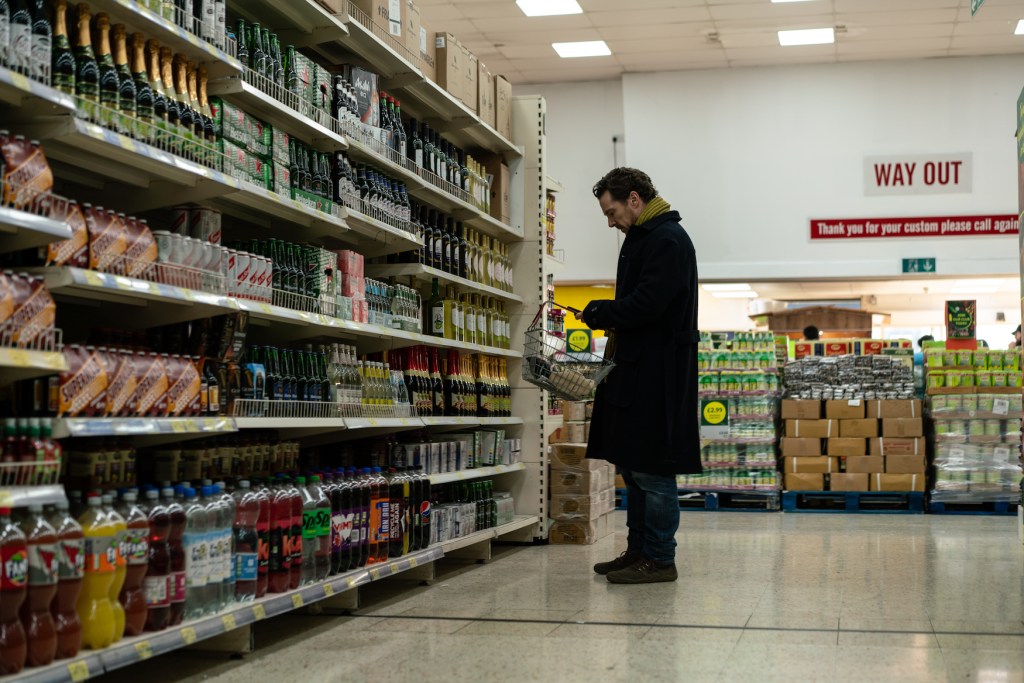
Dad’s overreliance on his wife to raise two growing boys while he holed up in his room illustrating whatever he did as a day job would have probably meant an efficient home designed by a home-maker wife. I’m not asking for additional backstory whether the wife worked or whether she nagged her husband or children. But the house would have had some organization and some color to indicate the the wife was indeed queen of the household. The dark wood and claustrophobic house sure helped the gloom and doom mood of the scenes – but also meant an absence of any female presence even before death. Like it’s just drab. The level of disarray that the house was in in such a short period since her death suggests Dad almost never cooked for his family (not even for a barbecue in the garden during summer?) And leaving pots in the sink meant he never used the dishwasher (nor his kids, who would’ve understood how a dishwasher worked, even if we say Dad was far too depressed to do the dishes.) Middle-class actually meant routines, like putting out the recyclables on recycling day, farmers’ market was every weekend (not at Tesco’s which what the supermaket he went to looked like. Can’t cook, can’t do dishes? He would’ve been buying food from H&M or Waitrose (they have wonderful food) if he actually lived a comfortable middle-class life that the crow snided at him. In the brief time I lived there, I learned that London actually has a class structure, from accents to where you bought your groceries from. His wife would’ve worked, schooling the children would have been expensive even though they went public (they didn’t go in uniforms.)
Prior to the crow’s line about the grieving white widower, the film was okay. The crow was a monster menacing a grieving English family. But the line just confused me whether the makers understood this very text that they’ve included in the film. As almost any book can be impossible to literally adapt onscreen one hundred percent, the successful ones always boil down to what choices the filmmakers made to adapt the source. Barbican? That would have suggested an academic family, his boys privately-schooled, and less clueless. The snide wouldn’t have worked at Dad if they were all false. Was it sarcasm then? Dad couldn’t have cared less.
The manner by which he was portrayed, Dad is a cypher, not a real urban person from the UK that says yes this is a real person with real feelings, rather his feelings (outright or suppressed) verbalized by the crow are just bullet points from a psychologist that no longer bears any sense of poetry. The crow it seems is Dad’s subconscious reified. That memory sequence seeing his dead wife on the snow wasn’t a statement against religion or something deeper, it was to say her death had become a burden – a cross – that he had to contend with. Nothing deeper than the despair Dad is wallowing in.
To be fair (again) Cumberbatch does excellently as a husband and father refusing to let go of his beloved. He would have enjoyed filming that drunken scene where in a paroxysm of despair and inebriation, he childishly calls out “I want her back!” before the crow possesses him. Impressive exhibition of acting.
Making the first half of the film tonally horrific was a choice. Making the other half the crow’s psychotherapy of Dad and his sons – but at the same time muffling the crow’s voice – was a choice. Filmmaking involves making choices, and this is one result of those choices. Maybe it worked for the makers.
Efforts were made to keep this production net-zero emissions, which is commendable. However, judging by the way creative decisions may have been made in the making of this film, I have some concern over Cumberbatch the producer (as “a” producer, whose part of the job is to look at the big picture of the picture.) Surely at some point he would have wondered about the inconsistent tone, the imbalance of character edits and the just the lack of layers in the narrative. The director Dylan Southern has the technical aspects covered. He is skilled, granted. We just need more poetry in the film as book is literally that.
It’s a case of almost there but not quite; half-wrong but also half-right. Overall it’s an honest, earnest effort to translate to the screen what was already reified by the book, minus the poetry.
The Thing With Feathers is now showing exclusively in Ayala Malls Cinemas nationwide.
Images and trailer link from Ayala Malls Cinemas.
 acid reflects
Leave a comment