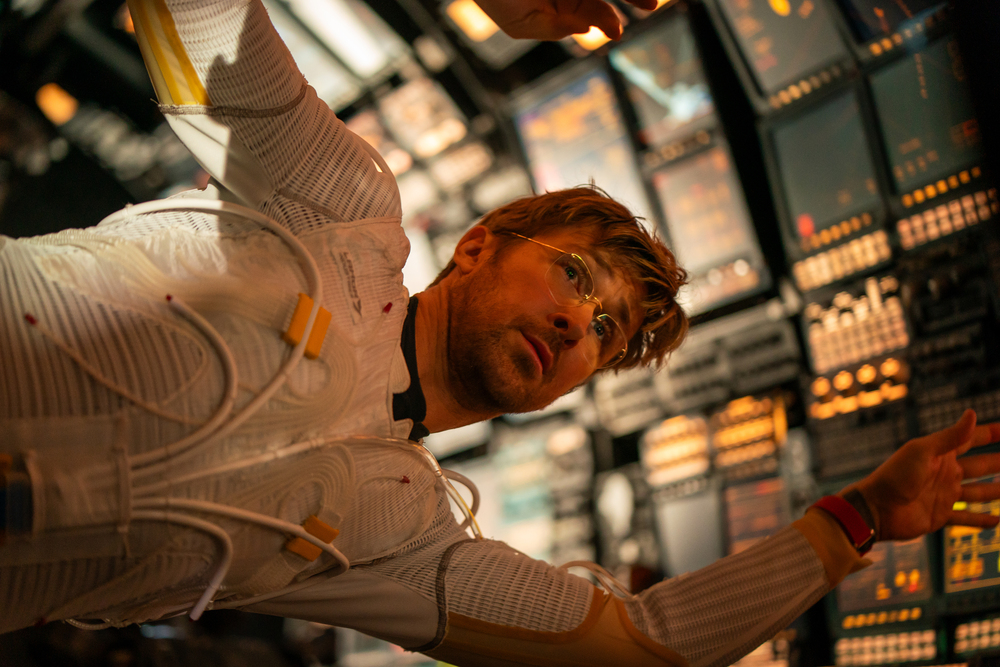
It’s a very tricky situation, the business of adapting the page to the screen. What to keep, what to take out, should it be literal, should it be revised. The best ones understand the core of the material, but also understand the audio visual medium of cinema. We’ve all heard stories of the struggles to adapt a book to the screen, especially from sci-fi and fantasy titles: David Lynch’s Dune (1984) (heck, Jodorowsky’s Dune), Denis Villeneuve’s Dune (2021), Miramax’s suggestion to Peter Jackson to just make one two-hour Lord of the Rings movie. And then we have Andy Weir’s The Martian, a rare commercial and critical success on page and at the boxoffice. That same screenwriter Drew Goddard understood the assignment and deftly translated Andy Weir’s 2021 laboratorial novel Project Hail Mary for the silver screen, visualized into a spectacle by the directing duo of Phil Lord and Christopher Miller. The result is not only a proper adaptation fit for the IMAX screen, but an audacious work that brings the awe back in space mission cinema last experienced in Gravity (2013.)
To fans of the author and the book who expect a sort of The Martian 2.0 (or even those who preferred not to have another Martian) where the main character conducts a barrage of sci-fi procedural McGyverism in order to disentangle himself from the science-problem-of-the-moment (that made The Martian competence porn The Pitt on Mars) – Hail Mary on screen removes almost all of that. Which I liked. Other fans are free to disagree.
SOME SPOILERS AHEAD to readers of the book and to non-readers alike.
Ryland Grace (Ryan Gosling) wakes up in a spaceship not knowing who he is or why he is there. In the course of poking around the ship, Grace experiences flashbacks that tell his journey.
Sometime in the near future, scientists from around the world discover that an alien substance is eating up the sun’s heat, with only thirty years projected before earth is plunged into darkness and all life is extinguished. An international team has been assembled to solve the problem, with the former chief of the European Space Agency Eva Stratt (Sandra Hüller) in charge with absolute authority.
Stratt descends upon a nondescript junior high school to recruit science teacher Grace, on the strength of his background on molecular biology and doctoral research paper on non-water related lifeforms. Grace is one of those cool high school teachers whom the students like – in part due to his deftness to explain science concepts in ways that his “kids” would understand and appreciate. Grace is intruiged by the tiny creatures called astrophages eating up the sun’s heat and decides on the spot to join Stratt’s team, if only slightly reluctant as he confesses no expertise on any scientific field. Stratt begs to disagree, but she has no time for small talk.
Back aboard the spacecraft Hail Mary, Grace remembers how he met his crewmates (Yao, played by Ken Leung, and Ilyukhina, played by Milana Vayntrub) both of whom, sadly, never woke up like he did during the spaceflight. He sends them off in a touching and heartfelt space funeral, even though he (and us, the audience) have barely known them. Gosling sells this scene really well.
The Project (or mission) was to send a three-person scientific team to study a distant star Tau Ceti that was not infected by the mysterious astrophages, and find ways based on this new data to stop the phages from completely eating our own solar system’s sun before it’s too late. But such was the distance between Earth and Tau Ceti that the mission was deemed suicidal (one-way) and only probes (like space drones they have dubbed “beetles”) will travel back to earth with the information that the mission has gathered, hopefully with a solution. It’s a long shot with a slim chance of success (hence, Hail Mary) but uninfected Tau Ceti is the only hope that our scientists have.
Without the pilot Yao and the ship engineer Ilyukhina, Grace is left to continue the mission by himself. However, as soon as Hail Mary arrives at the Tau Ceti system, a nearby object decides to blip itself to fly next to the Hail Mary. Soon the “Blip-A” has attached itself with the Hail Mary with a strange umbilical tunnel to Hail Mary. At the far end of that tunnel, separated only by a layer of glass-like panels, Grace meets a spider-like five-armed rock creature whom he nicknames Rocky (voiced by James Ortiz).
Through a series of tests and interactions, Grace and Rocky develop a system of communication based on sound, but also a way to travel between spaceships, despite the biological differences. Rocky is an excellent engineer from the planet Erid, and they can build almost anything, even though their technology is slightly less sophisticated than human tech. Grace learns that Eridani’s sun is also dying due to the astrophages just like Earth’s, and his planet sent them out to find a solution in Tau Ceti, exactly similar to Project Hail Mary’s mission.
Except that Rocky’s original crew of 23 companions have all died under conditions that Rocky could not understand. With a common goal, the Earthling and the Eridanian develop a buddy friendship to use their knowledge of science to solve the mystery of the astrophages together and find a way to stop the microbes from destroying life in their respective solar systems. The scenes between Grace and Rocky are earnest and genuine. Maybe the production’s decision to use a puppet instead of a CGI creature helped Gosling in relating with Rocky’s character on-cam. Rocky is adorabe as a puppy, annoying as a roommate and hyper active as a child. In many ways the creature serves like a robot sidekick in another space cowboy show. Rocky as a character is like an adorable talking pet robot, and that’s largely due to the book. I would want a Rocky of my own right now, thank you.
The question in this story is not whether they find a cure to the astrophage cosmo-demic. It’s whether the buddy aliens (Grace and Rocky of course) are going to survive long enough to save each of their planets. Cue tissues.
Gosling is no stranger to mission to outer space films, having played US astronaut Neil Armstrong at the height of the cold war in Damien Chazelle’s First Man (2018). So he already has had fake zero-gravity and ‘spaceship piloting” experience. Reading the book, the sarcastic science teacher Rylan Grace did sound like Gosling – the type of unassuming hero hinding under a facade of science nerd that fits Gosling to a T. Plus, his Academy Award pedigree is a reminder that those sad eyes of his can definitely convey depth and emotion.
I wish the movie Stratt was a little colder like the book Stratt, I found the dragon lady act a lot funnier that way. Movie Stratt evoked a weird sexual tension with Grace, which I found a little off. No question that the talented Ms. Hüller (Anatomy of a Fall, The Zone of Interest) can pull it off, so maybe the “warmer” Stratt is a version by the fimmakers.
As I have mentioned, the film removes a large portion of the procedurals in the book, but in several ways show a shorthand visual that reference the source. The entire thing about nitrogen-resistant astrophages in the atmosphere of Venus is gone, but the culture of Taumoebas is shown though shortcutted. Developing the language translation is shortcutted, no base-six counting nor explanations why the Eridians have yet to discover time dilations or relativity. There are a few minor changes too, like giving Rocky a partner back home in Erid (I don’t remember that from the book, so if it was there, my bad.)
The entire astrophage retrieval scene in the atmosphere of Adrian was both visually stunning and palpably thrilling. There was complete silence (of the bated breathing type) in the cinema when that scene ended.
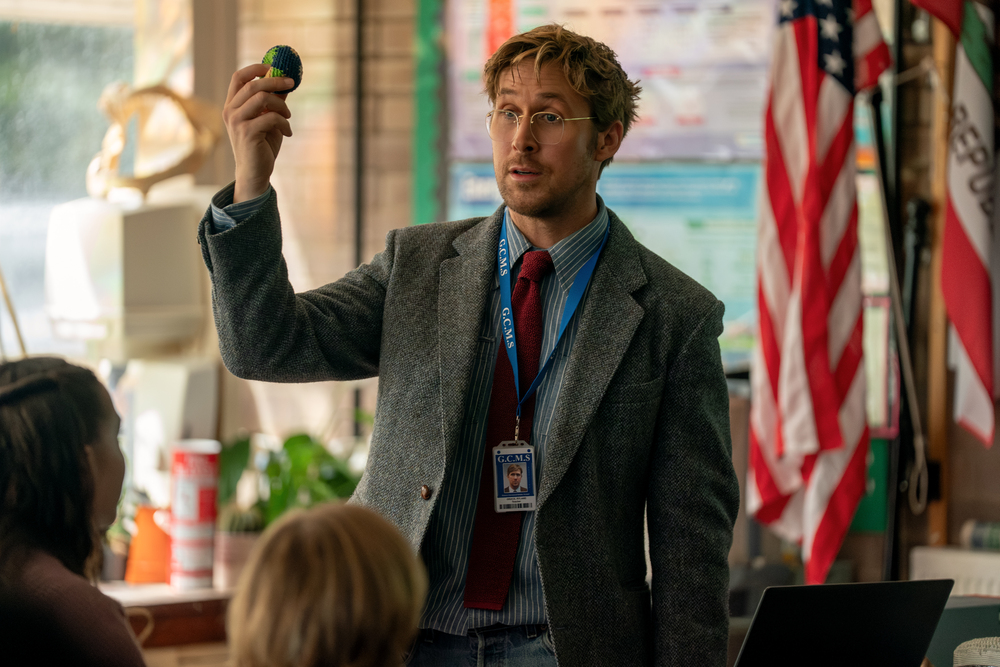
Ryan Gosling stars as Ryland Grace in PROJECT HAIL MARY, from Amazon MGM Studios. Photo credit: Jonathan Olley 
Sandra Hüller stars as Eva Stratt and Ryan Gosling as Ryland Grace in PROJECT HAIL MARY, from Amazon MGM Studios. Photo credit: Jonathan Olley © 2026 Amazon Content Services LLC. All Rights Reserved. 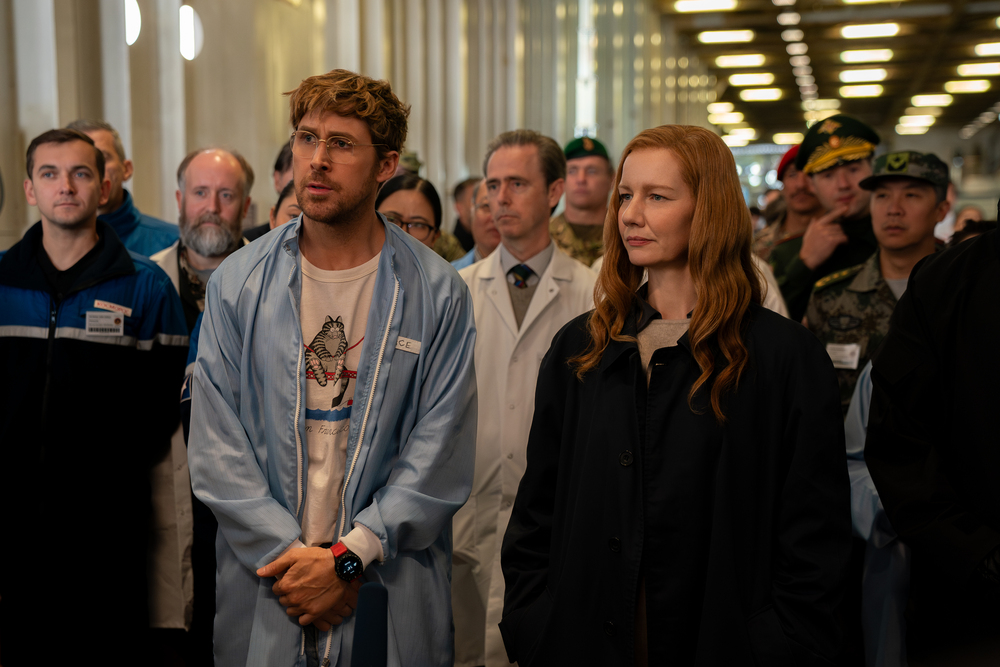
Ryan Gosling stars as Ryland Grace and Sandra Hüller as Eva Stratt in PROJECT HAIL MARY, from Amazon MGM Studios. Photo credit: Jonathan Olley © 2026 Amazon Content Services LLC. All Rights Reserved. 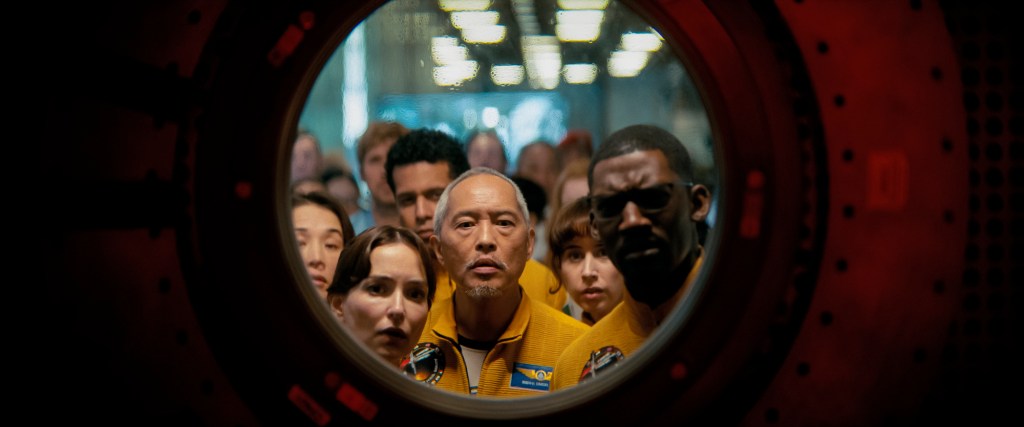
(L to R) Milana Vayntrub stars as Olesya Ilyukhina and Ken Leung as Yao in PROJECT HAIL MARY, from Amazon MGM Studios. Photo credit: Courtesy of Amazon MGM Studios © 2026 Amazon Content Services LLC. All Rights Reserved. 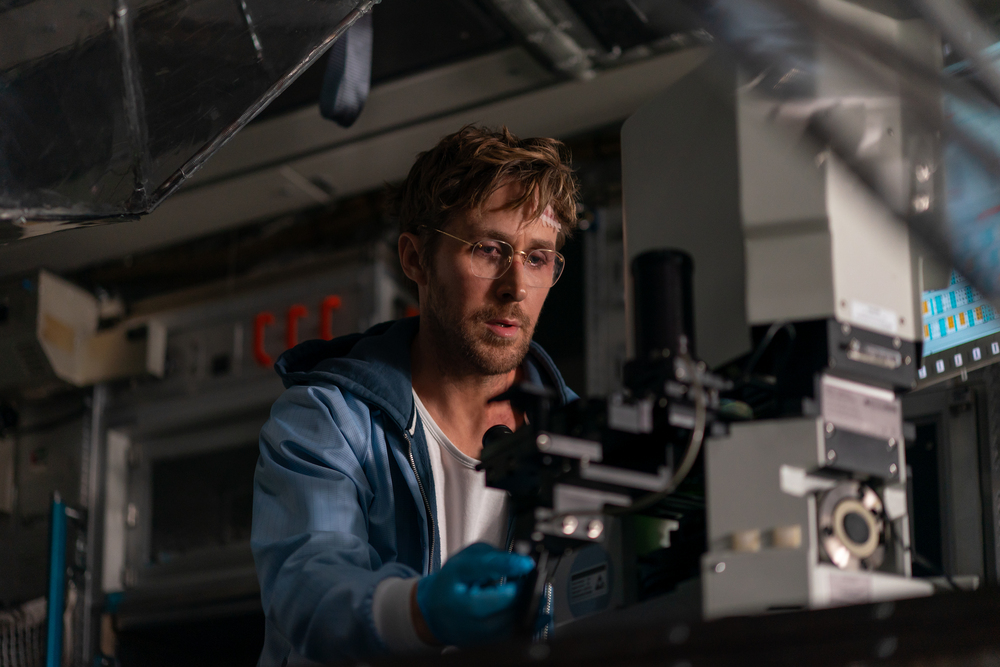
Ryan Gosling stars as Ryland Grace in PROJECT HAIL MARY, from Amazon MGM Studios. Photo credit: Jonathan Olley © 2026 Amazon Content Services LLC. All Rights Reserved. 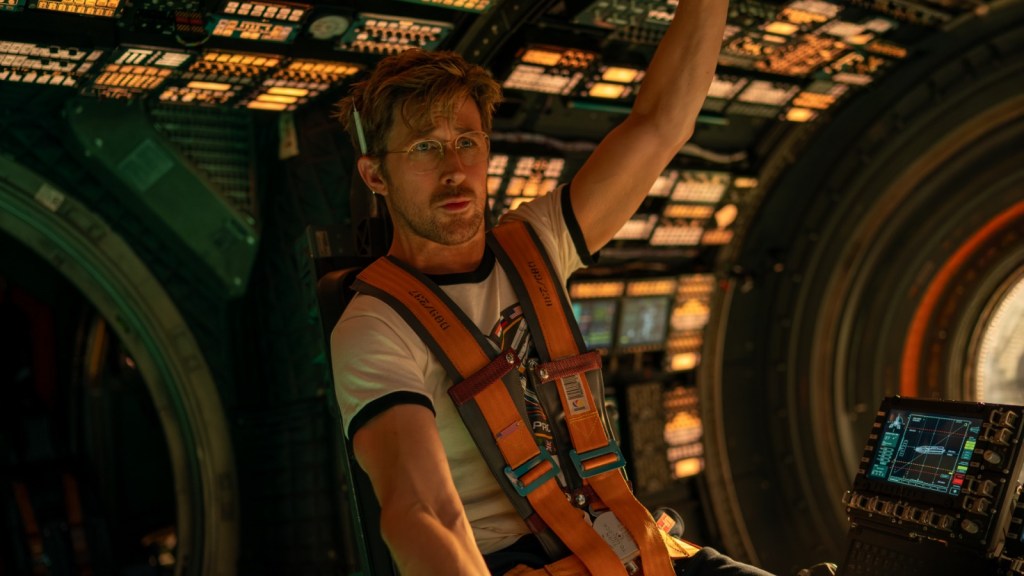
It’s a fantastic adaptation with a major handicap – that beyond its “we’re all in this together to save our planets” message, the film could benefit from a little more depth. No philosophical debate between science and religion like Robert Zemeckis’ Contact (1997) or alien as a christ-like redeemer warning humans against self-destruction in The Day The Earth Stood Still (1951). Maybe I’ve lost some of the symbolisms in the xenonites or Blip-A. Maybe it is just about the amazing journey of two different species together. Just maybe, something not so bleak, for once.
While the book explores a few science ideas that warrant discussion outside the page: thoughts on a shared evolutionary ancestor between Earthlings and Eridians from cosmic panspermia, or Grace’s doctoral thesis that got him the Hail Mary gig in the first place – life that doesn’t require water, H20, the film is about My Buddy from Another Planet.That’s not necessarily a bad thing. It’s just not very deep. The main draw to an Andy Weir story is competence porn from a relatable scientist who makes science experiments of varying complexity for survival not only humorous, but accessible. For this story, maybe “fist my bump” in the face of overwhelming odds is the philosophical message, and that is enough. In the process of adapting page to the screen, the filmmakers of PHM seem to have decided to let go of a huge chunk of the science procedurals to make it less hard science, but also give enough time to amp up the emotions. In so doing, the makers removed a large part of what made it an Andy Weir story while making it more resonant. It was a choice, for sure. I liked it, but it’s less Andy Weir. I say it’s a good adaptation, while this may also sound like it’s a bad one.
A minor gripe is the inclusion of gospel music at the credits, which had no place in the book as well as the film. It was as if some religious interest would not let a sci-fi film go without any mention of Jesus. Honestly, it sticks out like a sore thumb even though the music is lively and uplifting. I’m serious.
I would even dare say that Project Hail Mary as a Best Picture contender in next year’s awards season is an understatement. It is too good to simply say that. It excels in enough cinematic elements to push it to the pinnacle of awards contention. Editing, Music, Sound, Visual Effects, Cinematography, Daniel Pemberton’s musical score. and Gosling’s acting. We’ve seen some Best Picture hopefuls with fewer category achievements.
Somehow, Goddard, Lord and Miller have turned a hard science fiction story about saving planets and their inhabitants into a relatable buddy film that simply overflows with optimism and heart, no matter what lifeform or atmosphere. They may have removed some of the experiments, but they also made sure that teacher Ryland Grace is kept, in a package equally amazing whether seen under a microscope or through a petrovascope. Such audacity to amaze, amaze, amaze.
Project Hail Mary is in Philippine cinemas March 18th nationwide, from Columbia Pictures.
Images and link courtesy of Columbia Pictures.

 acid reflects
Leave a comment