#Brightburn – a genre-defying, intriguing concept that sounds brilliant on the outset, but execution and treatment somehow disintegrate before the story hits the ground. What would an evil Superman do to the planet?
Elizabeth Banks and David Denman play Tori and Kyle Brenner – a childless rural couple who find a child inside a crashed meteor. The child grows up with care and love, though bullied at school for being shy and exceptional. When Brandon reaches the age of 12, sinister and brutal things happen as soon as Brandon hears the calls of the thing hidden in the barn.
Elizabeth Banks stars in Sony PIctures’ BRIGHTBURN.
Tori Breyer (Elizabeth Banks) in Screen Gems’ BRIGHTBURN.
Brandon Breyer (Jackson A. Dunn) with his dad Kyle Breyer (David Denman) in Screen Gems’ BRIGHTBURN.
BRIGHTBURN Brandon Breyer (Jackson A. Dunn)
Tori Breyer (Elizabeth Banks) in Screen Gems’ BRIGHTBURN.
If it sounds like an evil Superman origin, it practically is. The concept is very intriguing, and packaging this as a horror film is almost genius.
Except that the film hardly functions as a proper horror film even though it’s replete with jump scares. Horror has to build up, but most importantly, audiences should be able to understand the mechanics what makes the thing horrific in the first place – knowing this builds the tension. I can’t even say that it’s because there’s an attempt by the filmmakers to subvert the genre, because they bothered for the jump scares. It’s a horror film, plain and simple. But it ignores to make proper preparation to bring the audience to that state of disbelief (Why does Brandon interpret “Take the planet” to mass slaughter humans? Is he acting that way due to pubescence? How could he change his personality literally overnight? Why does the scene abruptly, confusingly cut away to a dream sequence immediately after the couple makes a big argument? Etcetera.) I’ll blame the writers and the director for this.
It was interesting at some point when the drama seemed to explore the struggles that the couple were facing considering the bloody circumstances involving Brandon soon after his 12th birthday. But no. What’s more bewildering is how the previously-reliable Ms Banks seemed to have winged this production to look wooden in her scenes. Those eyes were dead, and she doesn’t look like she really cares for the troubled son.
Watch for the premise, but I can’t promise satisfaction.
The Curse of La Llorona
Directed by Michael Chaves
Based on the pan-Latin folklore
R13
La Llorona does the James Wan- trademark jump scares right, which it has aplenty. The story and concept though are sadly diluted.
Based on the Latin-x folklore about a weeping woman cursed to roam the earth in search of the souls of the children she murdered, La Llorona is yet another branch in the ever-expanding Conjuring universe of supernatural horror films that began in 2013.
The story begins with a short flashback into how La Llorona gets cursed in 17th century Mexico. Interesting stuff. Forward 300 years later in 1973 Los Angeles and the story focuses on social worker Anna (Linda Cardellini) who is investigating the disappearance of two children belonging to Patricia (Patricia Velasquez) – a mother under Anna’s supervision.
Anna’s interference seems to have had dire consequences after the two boys are found dead near a river. That same night, Anna’s own children are tormented by La Llorona (Marisol Ramirez.)
Anna and her children initially dismiss what happens to them, until the situation gets dreadfully worse and they seek the help of former priest turned demon-hunter, Rafael (Raymond Cruz.) They set a trap at Anna’s house, which almost fails until Anna’s faith is restored.
It’s pretty generic, low-budget but decently-made jump scare of a movie that sadly fails to build on the folklore that spans across Latin America, meant to scare kids from going out late at night.
Anna is given a character flaw (her non-belief in religious things, despite being historically Roman Catholic) possibly to add to her character’s journey that would somewhat require her to grasp some belief in order to defeat the curse.
But what is actually “the curse”? Is it seeing and getting abducted by La Llorona? The mechanics of getting cursed suggest any child near a water source who is approached by a weeping woman. Or is La Llorona herself the cursed entity, judging from the backstory?
At some point, the story becomes interesting when Anna’s fate is ironically upturned when the social worker herself becomes investigated for child abuse. The story doesn’t build on this either, which could have made it darker and more tragic. The story – and in turn, everything else – feels diluted.
With vague mythology, the film boils down to jump scares to deliver the frights for what could have been a fantastic foray into Latin American superstition that is awash with ghouls and demons. Instead, it’s a mere sidestep from the main Conjuring storyline, which of course is the intended moneymaker.
La Llorona opened yesterday in theaters nationwide.
#PetSematary
Directed by Kevin Kölsch, Dennis Widmyer
Based on the novel by Stephen King
The bottom line: Strong performances, strong atmospherics make for great suspense and creepiness, except those are thrown out the window in the last ten minutes. But still a hair-raising rumination on death and grief.
It’s a pretty common horror story scenario: a city family moves to a quiet neighborhood to start anew. Spirits are disturbed. Horror ensues. Many of Stephen King’s stories usually start out simply before turning for the worse, and Pet Sematary is quite the archetype.
There’s no point to not spoiling this one, no? The novel came out in 1983 and the first adaptation was in 1989.
Louis Creed (Jason Clarke) takes on a new job as an emergency doctor at a local hospital in Maine and relocates his family from Boston.
Not soon after, the inquisitive young Ellie (Jeté Laurence) discovers a strange landmark in their forested backyard – a cemetery for pets that locals seemingly have used for quite some time. How cool, right?
The Creed’s close neighbor Jud (John Lithgow) knows the story behind the cemetery and makes friends with Ellie.
Tragedy strikes when Louis and Jud find the family cat Church dead and mangled beside the killer road. Afraid that Ellie will despair, Jud urges Louis to bury Church in the cemetery in the dead of the night – Louis seemingly aware of what was to happen if they did even if Jud didn’t fully explain what would.
The results couldn’t be more tragic – and even more after an accident claims Ellie’s life. Grief will not save Louis and his family.
Jeté Laurence as Ellie, left, and Amy Seimetz as Rachel in PET SEMATARY, from Paramount Pictures.
PET SEMATARY, from Paramount Pictures.
PET SEMATARY, from Paramount Pictures.
Jeté Laurence as Ellie in PET SEMATARY, from Paramount Pictures.
Jason Clarke as Louis in PET SEMATARY, from Paramount Pictures.
Left to right: Jason Clarke as Louis and John Lithgow as Jud in PET SEMATARY, from Paramount Pictures.
While the film is an updated retelling of King’s classic, the filmmakers make use of old-school but very effective horror movie techniques.
The movie embraces literal and figurative darkness, enveloping the frame in obscurity and mystery that only amplifies the creepiness and the coming dread. Many scenes would look dark, but that’s the point. There’s also a nonexistent time element (Thanksgiving and Ellie’s 9th birthday were timestamps) but the days and nights seem to roll as if the place existed in its own nook in the universe. Not sure if this was by design or accidental editing – but I liked the result anyway. So creepy when you’re thrown in a situation where you aren’t aware when and where you are, like in a strange dream.
As the story sinks deeper into darkness, Louis descends deeper into grief and madness. We’re treated to heartbreaking, emotional performances from Clarke and Amy Seimetz who plays Louis’s wife Rachel. This is what the film plays well – grief and the consuming denial of death and separation, especially by parents. Indeed, no parent should ever have to bury their child.
But the film also doesn’t forget to give the chills, as we are reminded when the resurrected Ellie chillingly says she has no need of her mother anymore. Or to scare, as soon as Ellie comes back. Good job, Laurence.
However, the filmmakers seem to have taken liberty towards the end when all this sad poetry is thrown out the dumpster for the usual Hollywood taste for the undead. Still, it’s miles better than the 1989 movie.
Images and trailer link from United International Pictures.
#Shazam!
Directed by David F. Sandberg
Based on the DC Comics characters created by Bill Parker and CC Beck.
The bottom line: Shazam! is pure childhood wish fulfilment that throws you back to the days when you first started liking superheroes.
It’s quite curious that Warner Brothers and New Line undersell this fantastic tale with basic, somewhat subdued trailers and visual marketing that only shows the costumed Zachary Levy in various poses because it’s a big surprise that #Shazam! has a complete, family-oriented story with solid storytelling, bigger-than-life cinematics, and unbridled escapist entertainment.
WITHOUT (much) SPOILERS, as I can.
Fourteen-year-old Billy Batson (Asher Angel) isn’t keen on joining his new foster family, the Vasquezes in wintertime Philadelphia. He’s been deliberately running away from every foster home in an unsuccessful attempt at finding the mother he lost as a child. But the optimistic, cheerful Vasquezes seem to understand him quite well since they too were all orphans themselves.
Meanwhile, the Wizard Shazam (Djimon Hounsou) has been in search of a worthy replacement to his aging, weakening self for many years, barely holding back the Seven Deadly Sins from escaping the Rock of Eternity chamber to unleash hell on earth.
Rich scientist Dr. Sivana (Mark Strong) who has discovered his way into the Wizard’s chamber is intent on claiming the magical powers of the Wizard for himself.
So for his final attempt, the Wizard finds Billy and with the magic word, transfers the wisdom of Solomon, strength of Hercules, stamina of Atlas, power of Zeus. courage of Achilles and speed of Mercury to become the best version of Billy – Shazam (Zachary Levi.) Looks like a grown-up, but basically 14 and 1/2 on the inside.
Confused, Shazam hurries back home to seek advice from the superhero geek roommate Freddie (Jack Dylan Grazer) who essentially becomes his mentor. Plus/minus a few sibling issues that they have been thrust into as a consequence of these new daily and magical developments.
Sivana isn’t as cheerful as the Vasquezes, though, after the Seven Deadly Sins took over his body, they’ve all been hell-bent on taking Shazam’s powers. What would poor Billy do, if the evil Doctor came for his new siblings?
Pardon the lengthy summary. It’s quite necessary to set up Billy’s relationships with his new family as this is the core strength of the film. From start to end, Shazam! sustains that thread of family connection in the narrative. A few scenes with parents Rosa and Victor (Marta Milans and Cooper Andrews respectively,) a scene with Mary (Michelle Borth,) with Eugene and Pedro (Ian Chen and Jovan Armand) and cute little Darla (Faithe Herman) – just a few meaningful scenes with Billy or with Billy as Shazam, but it is always there – the family. Casting cheers here for retaining the diversity of the Vasquezes and every one of them is just adorable.
The film also got the superhero origin down just pat – no extended drama on how to be worthy of the powers, we know from the get-go that Billy is a good kid looking for his mom (not Martha!) Just say the word and ZAP!⚡️he got the power.
If a superhero movie is only as good as its villain, then Mark Strong makes for a great case for delivering one of his most memorable villainous roles as the insidious Dr. Sivana. He may be all parts evil and brooding, but because of a back story, his Sivana is as hurt and as lonely as Billy is for his true parents – a great counterpoint to Billy’s Shazam with a very intense screen presence to boot. Like, people won’t mind cosplaying as Sivana at all.
In all this is the film’s unbridled, constant humor. Whether it’s poking fun at all DC and Warner Bros franchises to the dynamic duo of caffeine-charged motor-mouth Freddie (Grazer AGAIN making a steal for the show as he did in IT) and Levi’s surprisingly apt portrayal of a young teen trapped in a grown man’s body, eager to experiment on anything adults can (legally) do. Although I must observe, Angel has a slightly subdued Billy compared to Levi’s Billy-trapped-in-Shazam.
The film accomplishes so much without being too compicated, and that’s another one of its powers. In these days of super-sayyan mega-power, scorched earth, the-chosen-one-alone-can-save-the-universe type of films, Shazam! tones it down a notch and with a little family-friendly humor, throws back to the old days when superhero movies were plain simple fun (maybe since the Raimi Spiderman series.) It’s almost old-school but not feeling old at all. For superhero fans, that means going back to the young days of discovering why they liked superheroes in the first place. It’s plain-old joy.
There’s a slight caveat though. For a family-friendly film, this can get a bit dark and violent (no thanks, Dr. Sivana and demons!) and Santa appears in a not-so-jolly way. Best if parents can actually explain some things to bewildered children afterwards.
Feel free TO CHEER IN THE THEATER if you feel like it, because I did – A LOT.
Fresh off the success of Get Out and with the new Twilight Zone series on the horizon, Jordan Peele is fast establishing himself as one of the most exciting filmmakers of late. #Us firmly restates that observation.
Us
Directed by Jordan Peele
R16
The bottom line: A high-concept nightmarish reinvention of the American Dream, when it is turned inside out using a very big and sharp pair of scissors.
What starts off as a typical summer weekend trip to the beach in Santa Cruz for the Wilsons turns into a gruesome, horrific nightmare by nighfall as Adelaide’s mysterious past catches up on her and her family with very disturbing consequences.
For most of the film, it is the stuff of nightmares indeed as it is rife with disturbing images and a cautionary message to remind everyone to lock our doors and windows at night for the rest of our lives.
The beautiful, the talented Lupita Nyong’o carries the entire film both as the mother determined to save her children from this horror and as the creepy crazy doppelganger in red jumpsuits and the bigass scissors whom we definitely don’t want to see suddenly appearing in our living rooms. Nope, nope, nope. But the rest of the talented cast shine as well (Winston Duke, Shahadi Wright Joseph, Evan Alex as the Winstons) and Elizabeth Moss’s voiceless screaming scene is just incredibly done.
Kudos, too, to the film’s music, photography and editing.
The film’s creepiest are all lumped in the first act – mostly what we’ve seen in the trailers. As the film mystery unravels, it is interesting to see Peele toying with slasher film tropes, slicing in some humor from time to time. Really interesting stuff. However, I must register my dissatisfaction with the film’s third and final act. The mechanics of the story requires some explanation at some point, but lumping it at the end through a narration seemingly betrays the care and detail that the filmmakers have wrought prior to that point. It’s almost a, “What, now?” moment, thowing the last few scenes back into cheesy trope territory. But still with some layered meaning.
It may require several viewings to peel off these multiple layers and commentary that Peele heaped on this tale – not counting how many film genres he seems to have mashed together – but there’s no arguing the obvious that the filmmaker wants viewers to rethink their notions of safety and fear, in these days that terror may not necessarily come from outside but from within.
The flipside is that the film wants us to fear fear again. Best to check if you still have antidepressants in the medicine cabinet.
It’s not surprising that Peele caps the film off with the uppity song Les Fleurs from 4Hero (one of the tracks that I loved listening to back in college.) The song’s animated music video shows society’s underbelly turning things around (making the world colorful) after receiving powers from a mysterious flower (possibly a psychotropic drug.) As if America can’t smoke weed enough.
Do catch Us this weekend.
Trailer here: https://youtu.be/hNCmb-4oXJA
Images and trailer link from Universal Pictures.
The bottom line: Generic superhero origin, period-appropriate stuff.
By generic I mean that I was neither underwhelmed nor was I overwhelmed. Just whelmed, if you ask Dick Grayson.
Marvel Studios’ first female-led superhero is by all accounts entertaining enough and packed with action enough to let it stand safely among the other films of the MCU. It may not be Avengers-level in scale, but it’s also not Ant-Man and the Wasp level of foolishness.
By period-appropriate, it is set (almost entirely) in the grunge-era of the ’90s and carries with it dyadic interaction common in shows that time, apart from being peppered with female-vocaled pop/alternative songs of the time. There’s also a lot of ’90s referenced jokes that were quite honestly not superfly.
I say that, too, because this is not entirely a message movie. Sure it plays a certain amount of the Woman card – needless to say that the film’s release in on Women’s Month – but it plays the gender politics safely which should keep the angry anti-SJW mob at bay. More on this later.
It couldn’t get even more 90s with a car chase in the streets of Los Angeles early in the film as Kree-warrior Vers (Brie Larson) – freshly-landed on Earth – pursues shape-shifting enemy Skrull Talos (Ben Mendelson) leading up to that famous scene in the trailer where Vers dukes it out with an old woman inside a Metro car. Yes that action set piece was good – but each time a 90s soundtrack would kick in, I kept waiting for the Guardian Gamora to suddenly appear on screen and high-five with Vers. It really felt like the songs were done to mask the absence of a truly memorable thematic score for our protagonist.
Brie Larson is fantastic here, taking the emotional journey of a proud warrior-turned-inspiring superhero with care and a level of honesty. It’s a joy to see her one moment confidently striding – dare I say it, cocky-ly – inside that train car looking for Talos, and later on sharing quiet moments with Agent Fury (a de-aged Samuel L. Jackson) and her loved ones on Earth.
Which brings me to my final few points.
For a film that carries the woman card up its sleeves, the filmmakers (and the Studio) play it along in safe terms. Sure, it has the empowerment message within its DNA, but the message meant to inspire young women is just one of the many iterations of “finding the best version of yourself” in other female-led films of late as a consequence of #metoo. Yes it is appropriate given these times, but by staying safely on the ground in respect of (or fear of backlash from?) the MCU’s core fans, it feels like there has been missed opportunity here.
This is more pronounced in the film’s climax (which can be seen in the trailer) where Vers/Carol Danvers is shown in a montage of herself in various ages of her life literally “standing up” to the male naysayers that have kept her from achieving her truest potentials.
Sadly, at no point in the film is there an iconic image or a scene (the standing up is closest) to represent this key identity that sets Carol Danvers apart. Mine the trailers, the clips and the marketing images online and freeze any frame and tell me which one says that that is uniquely Carol Danvers/ Captain Marvel and no one else – no other superhero – has that representation.
Like it or not, Marvel’s first female superhero film will receive comparisons with its DC counterpart released two years ago. But my search for an iconic image in Captain Marvel is not merely a search for the Marvel version of No Man’s Land. The reason I am merely whelmed is because I find some lacking on the directing duo’s vision (visions?) We don’t have to go searching far from the MCU for moments like these. Captain America’s barefoot chase scene is very memorable. Each time Thor reaches out for Mjolnir is memorable. I was kind of searching for that here throughout the film because she deserves it.
I don’t know how this origin story stays close to the comic books. On paper, Danvers may be one of the most powerful beings in the universe. I didn’t see that, most especially with how or where she got her powers from.
Here we have a superhero that carries the name of the studio itself, and yet there is no moment apart from that accidental power that tells me unequivocally that Danvers is unique, that she is the only one who deserves to carry the name.
Pure luck, perhaps? Hopefully I’m wrong.
Images and trailer link courtesy of #Marvel Studios.
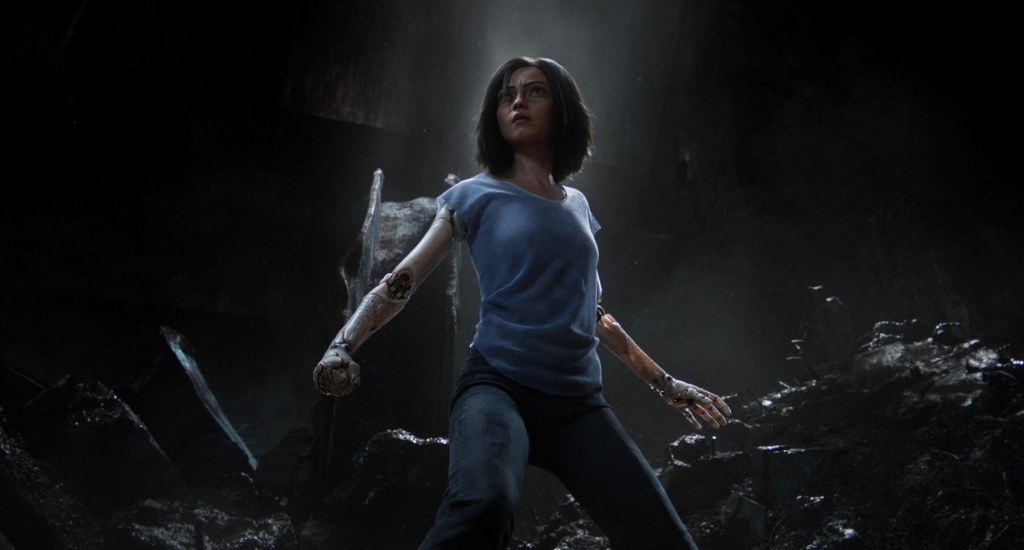
Alita: Battle Angel brings the cyberpunk manga source to thrilling action, but I cannot say the same for Rodriguez’s inert handling of the talented roster of actors. He got the cyborgs and action right, but not the humans. The visuals are top-of-the-line, the story needs oiling.
It’s the 26th Century and remnants of humans are living together with cyborgs in post-apocalyptic city of Scrapyard after a brutal war between Earth and (humans living in) Mars. Alita wakes up not knowing who or what she is, after cybernetic specialist Dr. Ido (Christoph Waltz) puts her together. As her memory returns, the more she realizes that she has to fight not only the mercenary cyborgs sent out to destroy her, but to rise up against the ruler of the floating city of Salem, Nova.
It’s nice to see that Hollywood is continuing to pursue the trend of investing on strong female characters in the lead considering that Alita isn’t as well-known as Wonder Woman (and even less than Captain Marvel.)
It may not necessarily be entirely to Rodriguez’s credit but to WETA’s for improving on their Gollum performance capture technology and translating a completely photorealistic character with convincing emotional delivery. There’s no uncanny valley effect here at all. On screen is a cyborg character on a physical, psychological and emotional journey to discover herself and her purpose – almost completely forgetting that what we are seeing is a computer-generated image seamlessly interacting with real humans. Credit to Rosa Salazar too for providing the base of that performance to feel “real.” This won’t be forgotten come awards season for Visual Effects next year.
The film has many visual set pieces (the Motorball, the first fight, the chase across Scrapyard’s streets, the brief flashback of the War on the Moon) all of which add to Alita’s resurgence as a freedom-fighting warrior.
And yet so many characters just stand about (literally) with brief exposures – including the arch-nemesis (uncredited surprise actor) – it’s almost frustrating to realize that this is a long tease for subsequent sequels.
One can almost seemingly distinguish that the spectacular set pieces were supervised by Cameron, and the inert characters were solely on Rodriguez.
It’s strange that the film can get quite gory and violent with a PG rating, while trying to package the whole as family entertainment that’s missing a funny talking pet. Alita’s love interest Hugo (Keean Johnson) declares at some point, “It’s a harsh world down here” – even though Scrapyard scenes depict what looks like a thriving multi-racial society living in relative peace. Never mind that this post-apocalyptic world didn’t seem to have been decimated by climate change.
Just a few words on Aquaman, Into the Spiderverse and Roma. Full reviews to follow.
Aquaman is a wild, non-pretentious, globe-trotting (globe-diving?) visual extravaganza of fun. Under the seas never looked this stunning. Character design is insane. Momoa’s Arthur Curry is charming as hell. At 2 1/2 hours, it’s worth every peso you sink in it.
It’s basically Star Wars: Episode IV of the Seas (or Thor, for the Marvel folks but more over the top and way better visuals.)
(Images from Warner Brothers Pictures)
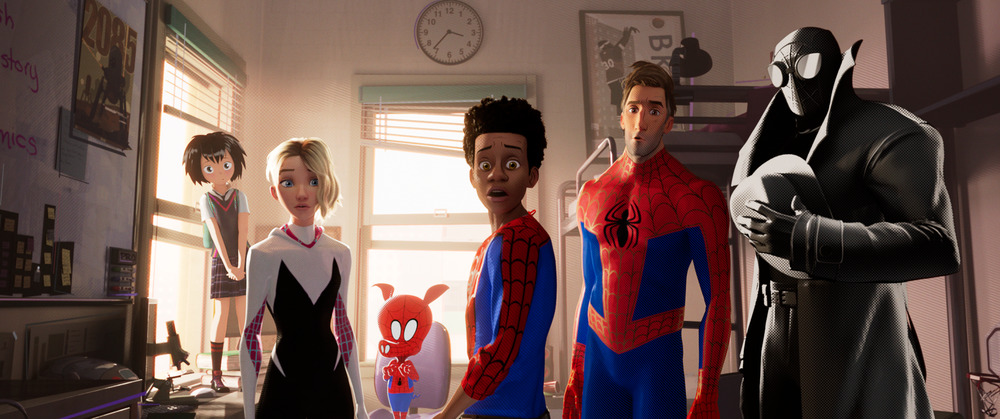
Into The Spiderverse is stunning a landmark in animation – an ecstatic fusion of vision, imagination and technique.
You know me – I’m not exactly a Marvel fan. I’ve constantly put Spider-Man down in my reviews. That changed when I saw Spiderverse last Saturday night.
It is art wrapped in the best mass-market package. Astounding use of multiple animation techniques coupled with honest to goodness good storytelling.
One of the best animations in decades, and one of the best superhero movies since the Tobey Maguire era. Believe the hype.💯(Images from Columbia Pictures)
Lastly, Alfonso Cuaron’s Roma from Netflix is sublime, essential, heartbreaking, breathtaking, unforgettable, glorious and pure Cinema.
Creed II and The Grinch opened this week in local (PH) theaters, while Widows opens on December 5th. The first is a very predictable crowd pleaser that’s pleasing to look at, sounds good to listen to, and has plenty to root for. The second is so Christmassy, you’re gonna die. The last one tries too hard to be important.
Creed II
Directed by Steven Caple Jr.
Based on characters from the Rocky film series
Link and images from Warner Bros. Pictures
Rocky simply refuses to die. They introduced Rocky as having Non-Hodgkin lymphoma in Creed (2015) but that didn’t seem to have any mention in Creed II. The point is, the Rocky story is far from over, even if this is about Adonis Creed. But here we are on the eighth Rocky movie. The first, third and seventh installments received Academy Award notices, so this series has a good history of watchability.
In the last film, Adonis Johnson (Michael B. Jordan) overcame his reluctance to take on the legacy of his father, Apollo Creed (Carl Weathers,) to become a professional boxer himself under the helm of former heavyweight champion Rocky Balboa (Sylvester Stallone.) He doesn’t win the title fight, but earns the respect of everyone establishes his name as Adonis Creed.
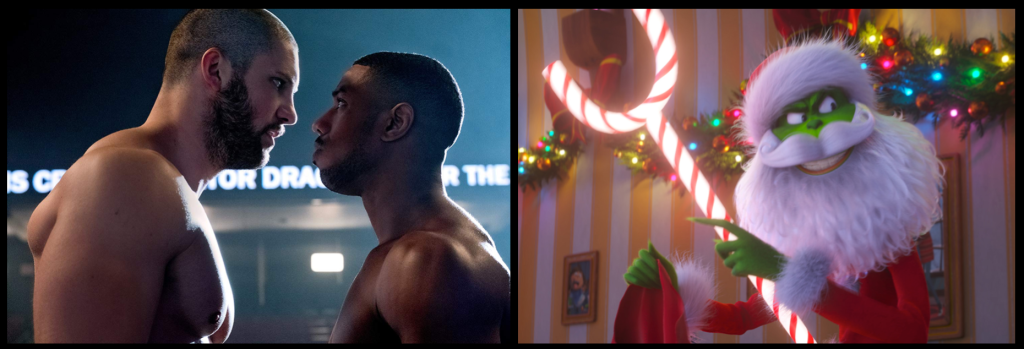
In Creed II, Adonis, now the light heavyweight champion, fights for the legacy of his child with wife Bianca (Tessa Thompson) against Viktor Drago (newcomer Florian Munteanu,) son of Apollo Creed and Balboa’s arch-nemesis, Ivan Drago (Dolph Lundgren.( Viktor, too has to fight for his own legacy – to reclaim his father’s honor in Russia, after being cast out since the defeat from Balboa. And so a battle is set between old foes and new.
There’s a lot of fan-service in this film, even if Balboa and Drago don’t exactly physically exchange punches (which is kind of a bummer, but we know they’re both ancient.) The setups are quite reminiscent of Rocky IV (the episode with Drago,) wherein the first encounter results in Creed’s loss after Balboa advises against the challenge, and the final encounter where Creed overcomes everything on Russian soil, this time with Balboa at his corner. To the tune of Rocky’s theme, of course.
Replace Bianca with Adrian, Drago for Drago, Creed for Balboa and you get the Rocky IV film again (in general, plot-wise.) It even includes Balboa’s signature back-to-basics redemption training, this time to the exalting baton of Ludwig Göransson music that will surely land onto most every gymrat’s motivational workout playlist.
The film is shot like a gorgeous sports documentary, performances are on point, especially Stallone’s, and the film has a bop soundtrack. Plenty of things to like.
It’s just that for most of the film’s two-hour-plus run, the film plays through predictable beats from setup to setup including Drago’s visit to the famed steps of Philadelphia Museum of Art, down to the last count in the finale fight when you see it. Rocky and Adonis’s dynamics are on point but trite, while Adonis and Bianca’s are almost perfunctory. It manages to stay engaging despite the familiar character challenges with heartfelt earnestness from the cast.
There’s no denying that there’ll be another Creed film down the line. Whether or not that Non-Hodgkin lymphoma will have any bearing on Rocky depends on the writers’ (Stallone included) whims.
========== The Grinch
Directed by Yarrow Cheney, Scott Mosier
Based on the book “How The Grinch Stole Christmas” by Dr. Seuss
With the aid of mechanical candy cane, the Grinch (Benedict Cumberbatch), disguised as Santa, steals every bit of Christmas from the homes of Whoville in Dr. Seuss The Grinch from Illumination.
The Grinch (Benedict Cumberbatch) prepares to brave the relentless holiday cheer of Whoville with his loyal dog Max in Dr. Seuss The Grinch from Illumination.
Cindy-Lou Who (Cameron Seely, left) has a secret plan to help her overworked mother, Donna Who (Rashida Jones) in Dr. Seuss The Grinch from Illumination.
The Grinch (Benedict Cumberbatch) warns his dog Max and reindeer Fred about the seductive power of the Santa cookie as he trains them to help him steal Christmas in Dr. Seuss The Grinch from Illumination.
(from left) Cindy-Lou Who (Cameron Seely) and her best friend Groopert (Tristan OHare) bask in the beauty of Whoville at Christmas in Dr. Seuss The Grinch from Illumination.
Link and images from United International Pictures
Dr. Seuss’s most famous scrooge gets a color-saturated computer animation treatment that’s bursting to the seams with Christmas joy and cuteness, it’s the other side of the same coin with Tim Burton’s The Nightmare Before Christmas from 1993.
Illumination studio’s The Grinch, the grouchy titular character (voiced by Benedict Cumberbatch) hates Christmas so much, he decides to end Christmas once and for all by dressing up as Santa and stealing all the Christmas-themed items and gifts in Whoville on Christmas Eve.
But a spunky little girl Cindy Lou Who (Cameron Seely) wants Santa to help her overworked mommy Donna (Rashida Jones,) and plots to trap Santa in her house so she can ask him her wish personally. Sounds like something The Grinch won’t like even more.
Faithful to the 1957 source material including the participation of Grinch’s loyal mutt Max, the film makes a quick statement to repeat the book’s critique of the commercialization (or materialism) of Christmas. The design takes after Illumination’s last animation The Lorax in 2012 but with far brighter and warmer holiday hues. Textures are far more advanced with the ruffling of fur and dynamics of wind and snow. We’ve come to a point when CG animation mimics motion in real life quite exactly.
But there’s nothing remarkable to say about this cute Christmas story about the more important things of the season except maybe to point out that the Grinch and Whoville universe exists in the same human universe that listens to the Jackson 5, Nat King Cole, José Feliciano and The SUpremes. It’s strangely distracting from the animated-ness of everything, and yet God Rest Ye Merry Gentlemen is sung by a choir to remind The Grinch about Jesus. Are there Catholic Whos too?
========== Widows
Directed by Steve McQueen
Based on the 1983 ITV series of the same name
Opens December 5 in cinemas
Liam Neeson and Viola Davis in Twentieth Century Fox’s WIDOWS. Photo Credit: Courtesy Twentieth Century Fox.
Widows Day 29_5.dng
L-R: Michelle Rodriguez, Viola Davis, and Elizabeth Debicki star in Twentieth Century Fox’s WIDOWS. Photo Credit: Courtesy Twentieth Century Fox.
DSC_8283.NEF
L-r, Elizabeth Debicki, Cynthia Erivo, Viola Davis and Michelle Rodriguez star in Twentieth Century Fox’s “Widows.”
Link and images from 20th Century Fox
Fancy a heist movie starring A-list actresses. No, not Ocean’s 8 – but that was more satisfying to watch. I don’t get how this film rates 90+% on Rottentomatoes, Widows tries hard to be important, tries hard to be relevant, tries to be artsy, tries do do and be a lot of things at the same time.
A botched robbery results in the death of four notorious criminals, including their high profile leader Harry Rawlings (Liam Neeson) who is implied to somehow be influential in the political circles of the South Side of Chicago. The money that Harry stole belonged to crime boss Jamal Manning (Brian Tyree Henry) who is now threatening Harry’s widow Veronica (Viola Davis) to return the money.
Armed with only a notebook from Harry, Veronica gathers the other widows left by Harry’s team (Michelle Rodriguez, Elizabeth Debicki) to plan a heist against Manning’s opponent, Jack Mulligan (Colin Farrell) who is from a prominent political clan. The odds are against the widows.
Key indicator of the film’s many ambitions is the explosive botched robbery escape that’s intercut for jarring effect with Veronica and Harry in the bedroom, sometimes in extreme closeups to Veronica’s eyes. Artsy? If only it were consistently so – editing doesn’t seem to have a particular philosophy or reasoning other than to sequence the events because the stylistic storytelling happens only in the beginning.
I’m tempted to declare clichéd character profiles (a snobbish rich woman, a struggling working family woman and a prostitute) but that’s just part of the frustration watching this experiment.
Shock value? There’s Daniel Kaluuya’s viciously cold Jatemme Manning, brother to Jamal and head henchman who stabs a paraplegic without blinking. Dirty old white politician? The senior Mulligan, Tom, played by Robert Duvall. MeToo, Racial Profiling, Corrupt Churches – etcetera, etcetera? It has those too.
What annoyed me to the end is not the myriad issues nor the overbearing grimness (yes I get it, it’s not really about the heist) – but I kept wondering what Veronica was doing the entire month that she could supposedly, as a smart woman in the film, have done in about two weeks? Really. We know what Rodriguez’s character was doing, we know what Debicki’s character was doing. Somehow, Veronica who is said to be with the Teachers’ Union, seems to be just going around town or lounging at home carrying the dog with nary a purpose, before crunchtime at deadline. Like she didn’t see that was coming for her driver, Bash (Garret Dillahunt.) It’s annoying when a character is presented to be smart, but is portrayed not being smart as they should be. Such is the film.
Just a few short notes on these three that come out in local cinemas this week.
Ralph Breaks the Internet
Directed by Phil Johnston, Rich Moore
Based on video game and Disney characters and the 2012 animated film
Rated G
Six years after the events of Wreck it Ralph, it’s Vanellope’s turn to get tired of the same old stuff she does racing the familair tracks of Sugar Rush at Litwak’s Arcade. But when the video game gets broken, Ralph (John C. Reilly) and Vanellope (Sarah Silverman) must navigate the digital world of the internet to secure a piece that will get the video game running again, or else the old cabinet is shut down for good.
In a rare feat of ingenuity that improves on the original, Disney manages to level up the visuals and scenarios here with a better flow in the narrative, significantly more textured palettes, and a show-stopping song worthy of a Disney princess.
While the first film mines gaming nostalgia for the laughs, RBTI satirizes almost everything humans obsess with the internet – from multi-platform gaming to algorithms to memes to the dark web and also the harsh commentary on social media. It’s a sly commentary on the funny and sometimes absurd things we do online – without mentioning porn, of course.
Interestingly, the two leads are engaged in a heroic quest that has no actual villain. They’re up against their own selves, with friendship and trust on the line. Those are themes were also in the first film, but the sequel presents these in ways that are more heartfelt. Until the last few minutes when an enemy emerges, then it’s back the the old adventure business.
But where it comments on the things we do on the internet, it forgets why we spend so much time, sometimes too much, of our real lives being online. Nearly half the world is yet to be connected. So it gets a score for being smart, but not enough to take the entire thing seriously. This is still within the realm of Disney, and Disney does fantasy exceptionally well.
Poking fun at all of its princesses, the film’s clear highlight is a hilarious encounter between Vanellope and the Disney princesses in a dressing room. Later in the film, Venellope realizes the fullness of her Disney princess status when she bursts out with a full-fledged princess song, composed by none other than Alan Menken, who is responsible for many of the most popular Disney songs to date. We can now add Vanellope’s “A Place Called Slaughter Race” to this list.
Voice acting is quite decent, too, with Gal Gadot’s race girl Shank as strikingly appropriate. But let’s not forget that, with the exception of veteran actress Mary Costa, all of the voices are played by the original actresses.
Make sure to sit through the credits for a worthy stinger.
===============
The Girl in the Spider’s Web
Directed by Fede Alvarez
Based on the books by David Lagercrantz and characters from Stieg Larsson’s Millennium series
R13
The goth girl with the perpetual bad hair day is back, this time not as the avenger of violence against women but as a Swedish James Bond out to thwart nuclear holocaust.
Lisbeth Salander (Claire Foy) in Columbia Pictures’ THE GIRL IN THE SPIDER’S WEB.
Camilla Salander (Sylvia Hoeks) in Columbia Picture’s THE GIRL IN THE SPIDER’S WEB”
Lisbeth Salander (Claire Foy) in Columbia Pictures’ THE GIRL IN THE SPIDER’S WEB.
Ed Needham (Lakeith Stanfield) Lisbeth Salander (Claire Foy) Mikael Blomkvist (Sverrir Gudnason) and Plague (Cameron Britton) in Columbia Pictures’ THE GIRL IN THE SPIDER”S WEB.
Images and links from Columbia Pictures
Golden Globe winner Claire Foy is the third actor to play antisocial hacker turned vigilante Lisbeth Salander in the third installment of the Dragon Tattoo series. A botched hack job nets Salander in the titular spider’s web spun by the Russian mafia Spider, US NSA spies and corrupt Swedish officials. In the film, Salander must retrieve nuclear code data stolen from her by Russian mafia before it lands into the wrong hands. That surely sounds like a James Bond plot.
Swedish actor Sverrir Gudnason is the latest to play investigative journalist Mikel Blomkvist who chronicles Salander’s missions. Everyone else in the film is either a new character or a replacement actor. New to the conflict is Lisbeth’s estranged sister Camilla (Sylvia Hoeks) who has a score to settle.
There’s some nice visuals here – it looks and feels like a slick European thriller, from the cold Swedish landscapes to strong color palettes in some scenes – until you remind yourself that Paul Greengrass reinvented the spy genre and made it more propulsive in Jason Bourne, and the stunning first Dragon Tattoo movie by David Fincher whose jarring images and editing allowed for goosebumps and chills down your spine. Watching Spider’s Web, one surely misses the Fincher touch.
With this installment’s pivot towards action, Spider’s Web plays down the psychological aspect of Salander’s methodology, betting on slick set pieces like the scene where she escapes on a motorcyle above a frozen lake instead of say, why she cant outwit her sister. Foy does enough to show some weight on the hacker’s implied dark past, but nowhere is this hacker equipped to take on a whole Russian mafia, let alone save the world, especially when the Russians seem to be always two steps ahead of her. Yes, she gets some help from Blomkvist and NSA agent Ed Needham (Lakeith Stanfield) – but that is the point: gone is the empowered female Batman who does things on her own terms. The slight improvement is that Salander is the center of the story here, as opposed to the previous installments which had Blomkvist leading the investigation while telling her story.
===============
Bad Times at The El Royale
Written and Directed by Drew Godard
R16
Bad Times at the El Royale is actually a good time to see a movie. If that blurb doesn’t make you scramble to the cineplex, maybe a half-naked Chris Hemsworth for nearly an hour will.
L-r, Jon Hamm, Lewis Pullman and Cynthia Erivo star in Twentieth Century Fox’s “Bad Times at the El Royale.”
Jon Hamm stars in Twentieth Century Fox’s “Bad Times at the El Royale.”
0237.psd
Jeff Bridges and Cynthia Erivo star in Twentieth Century Fox’s “Bad Times at the El Royale.”
_89A4327.CR2
Images from 20th Century Fox
It’s the late 1960s, a time when the sexploits of politicians made current scandals look like kindergarten play. Strangers descend separately on a seedy hotel on the border of Nevada and California, and no one looks like who they say they are. A priest (Jeff Bridges), a singer (Cynthia Erivo), a vacuum cleaner salesman (John Hamm) and a snobbish, sarcastic woman (Dakota Johnson) arrive one by one at the hotel and meet its only employee, Miles (Lewis Pullman.)
The story unfolds in one night from the perspective of each character, as they each settle in their rooms, beginning with the salesman who discovers that the hotel has its own secrets that it wants to keep. In a tragedy of errors, one character ends up dead, one character is shot, two characters are at each other’s throats, and the last one is joined by two more, with deadly consequences. The final two are the woman’s virginal younger sister (Cailee Spaeny,) and finally, the bare-chested Chris Hemsworth playing, of all things, an enigmatic cult leader.
From the director of The Cabin in the Woods (2012) comes a stylish mystery suspense that’s actually enjoyable to watch. I was not expecting anything prior to seeing the film, but so far Godard has yet to disappoint completely. There’s humor, a lot of mystery, and some suspense. It may burn slowly, but ends quite strong.
Watching the film reminded me of a stage exercise on timing actors’ cues and blocking, each time the story changes from the perspective of the succeeding character. There’s some humor in that by itself. Had the film been narrated and set a few more decades before, this movie would have easily been categorized as noir. What I mean is, the film definitely has a sense of style – maybe some references to Hitchcock humor – with design and lighting working in synergy to create appropriate tones.
The actors also seem to have had some fun while making the film, because it showed in their performances. Specifically: Bridges as the (supposedly) priest suffering from the onset of Alzheimer’s; Erivo who indeed turns out to have impressive vocals worthy of Las Vegas; and behold, Chris Hemsworth of Charles Manson proportions.
But however fun the movie is to watch, there seems to be nothing more underneath all the retro carpeting and hardwood floors. There’s no deep message, no poetry for introspection, no subversive undertones allegorical to the present day – just good craftsmanship, great ensemble chemistry and a juicy story (if macabre) that’s easy to digest. Maybe something about racial tensions, maybe something about the losses of war. Maybe nothing more. Just fun.
Hemsworth’s bare torso can sometimes be a distraction to the story, but that can’t be a complaint, right?












 acid reflects