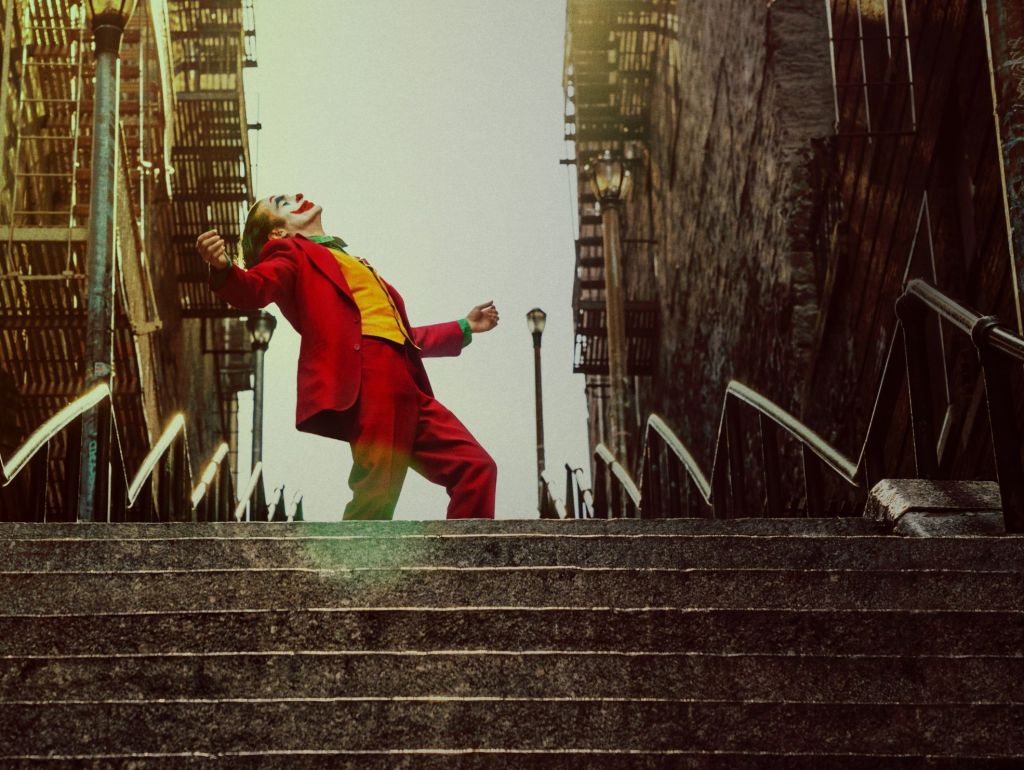
What blinding light, encased in darkness. One can’t look straight at Joker unflinchingly without taking refuge in its horrific cynicism.
The best way to watch this is not to think of it as not a comic book film. Those were my thoughts a few minutes into the movie. It’s a brutal look at how society rips away a person from itself until that person deforms and is rendered inhuman right in front of our eyes. In fact, the film’s weakest parts are the times when it connects to the Batman narrative, almost perfunctorily.
By extension – and thankfully the film is designed as a standalone film – it would be best not to think of Joker as the birth of a supervillain (how unfortunate that it is so.) However, and let this be clear, the depiction is of such intensity that some may not be able to separate that power from our reality. It’s one thing that the film provokes thoughtful discussion about many things – most importantly mental illness, but taken the wrong way, the film has that danger to invite further darkness into our real society. But it would be criminal to watch this film and only see the graphic violence. Violence is not the essence of the film, the loss of empathy is. When was the last time a movie had the potential to shake society to its core? The Golden Lion is very much well deserved.


(ALMOST SPOILER-FREE AS I COULD)
Arthur Fleck (Joaquin Phoenix) is a struggling comedian who takes care of his ailing mother Penny (Frances Conroy) in early 1980s Gotham City. He sees a therapist regularly to help him cope with his negative thoughts. Nobody likes Arthur, even his co-workers at the comedy bar. He likes his neighbor, Sophie (Zazie Beetz,) but it’s unsure if she likes him at all. He yearns to belong, and looks up to TV talk show host Murray Franklin (Robert De Niro) for inspiration. But every day is a bitter struggle for Arthur, and society doesn’t seem to want him to get better. Arthur gets broken, literally and figuratively speaking, and from there emerges a very violent person who calls himself Joker.
Director Todd Phillips (known for The Hangover series of comedies) paints a extremely unsettling portrait of a disturbed man rejected by an unsympathetic society. It just happens to be Joker, arch-nemesis of Batman from the comic books. I think that’s the best way to describe the film.
Director Martin Scorsese’s influence can be seen all over Joker – mainly, the grit and madness of Travis Bickle (played by Robert De Niro) in Taxi Driver and The King of Comedy (about a stand-up comedian – also played by De Niro – who abducts a TV host.) Alan Moore’s graphic novel The Killing Joke is also cited as an influence, but Joker has Taxi Driver written all over the place.
Joker doesn’t even appear until late in the film, and as a character study, the film gives ample time to portray Arthur’s progression (or rather, regression) into Joker. We all know Joker is a maniacal killer. For the same reason that he only appears late in the film that the body count in the film is low. How the film humanizes Arthur is the gem of the film. But in no way am I downplaying how gruesome and sometimes shocking the killings are.
I’ve already mentioned that one of the film’s main weaknesses is whenever it refers to the Batman universe. It sticks out and away from the more dramatic and important discussion it brings, which is about mental illness and empathy. But I do recognize how uniquely different and fascinating this version is from the usual Batman and even most comic book narratives we have already seen.
For years, mental health has been largely dismissed by society in general – and it’s the ugliest mirror that the film holds up against its viewers: that we as a society tend to forget specific members of our larger group. I have a broken right hand, but in no way is it dysfunctional. But that sometimes makes me think of myself as not being whole, and even though I do not struggle the same way differently-abled people survive on a daily basis, I often find it frustrating how the disabled are mere afterthoughts sometimes in the simplest of things like being able to cross a street or riding public transport.
But Fleck here is not an easy person to like, just as Joker is not someone to root for. This Joker may not be the same Joker in The Dark Knight, who calls for others to embrace their inner darkness – there is no, “Join my cause” here – but there is a depiction of what might become if we keep ignoring the likes of Arthur. In that sense too, Fleck’s character profile is different from Taxi Driver’s Travis whose descent into violence was an answer to his rejected masculinity. Fleck’s final scene with Murray (as the film’s climax) awkwardly spells out Joker’s politics: by the time Arthur has become Joker, he has rejected society altogether.
It’s almost redundant at this point to cite Phoenix’s performance as purely riveting. Sure, there’s considerable pedigree of talent assembled here on-screen and off, but there’s no denying that Phoenix is front and center of everything here. How the lens and light is framed on him; the unpredictability of the music; how the costumes speak to us about him; how the makeup pushes our buttons; how the gritty, slimy city looks, spitting on him. Which is also why the final scene looks and feels detached from the rest of the film, stylistically. But it is needed, to quash whatever dangerous glory the previous scene may imply (which for me would have been a more chilling end, but dangerous nonetheless.)
All things considered, Joker is a brave – but frightening – look into the origins of evil that happens when people look away from the Arthur Flecks of society. Warner Brother’s description of the film as a cautionary tale is on the dot. Whether one ends up liking the movie or not, Joker cannot be unseen.
Joker
Directed by Todd Phillips
Based on the character from DC Comics created by Bob Kane
Rated R16
Trailer here: http://bit.ly/JokerFinalTrailerPH
Images and trailer link courtesy of Warner Bros. Pictures

 acid reflects reviews
Leave a comment